
You do not need to speak Mandarin to travel China. WeChat Pay, Amap, and Baidu Translate handle most of the hard work. But 20 phrases will earn you genuine warmth from locals, get you out of situations no app can solve, and signal respect for the country you are visiting.
These are organized by situation. Pronunciation guides use rough English sounds — not pinyin tones, just something you can say immediately.
Key Takeaways
- Tones are not critical in tourist contexts – context and pointing cover most errors.
- Most useful emergency phrase: Jiùmìng! (救命!) – ‘Help!’
- Most useful daily phrase: Wǒ bù dǒng (我不懂) – ‘I don’t understand’
- For taxis: show your destination in Chinese characters – never try to pronounce a hotel name.
- Download Baidu Translate audio to hear correct pronunciation before your trip.
- A smile + xièxiè after any interaction is universally received with warmth.
The Complete 20-Phrase Reference
| Pinyin | Chinese | Sounds like | Meaning |
| Nǐ hǎo | 你好 | nee how | Hello |
| Xièxiè | 谢谢 | shyeh shyeh | Thank you |
| Bù kèqì | 不客气 | boo kuh chee | You’re welcome |
| Duìbuqǐ | 对不起 | dway boo chee | Sorry / Excuse me |
| Méi guānxi | 没关系 | may gwan shee | No problem / It’s OK |
| Wǒ bù dǒng | 我不懂 | waw boo dong | I don’t understand |
| Qǐng shuō màn yīdiǎn | 请说慢一点 | ching shwaw man ee dyen | Please speak more slowly |
| Nǐ huì shuō Yīngyǔ ma? | 你会说英语吗? | nee hway shwaw ying-yoo ma | Do you speak English? |
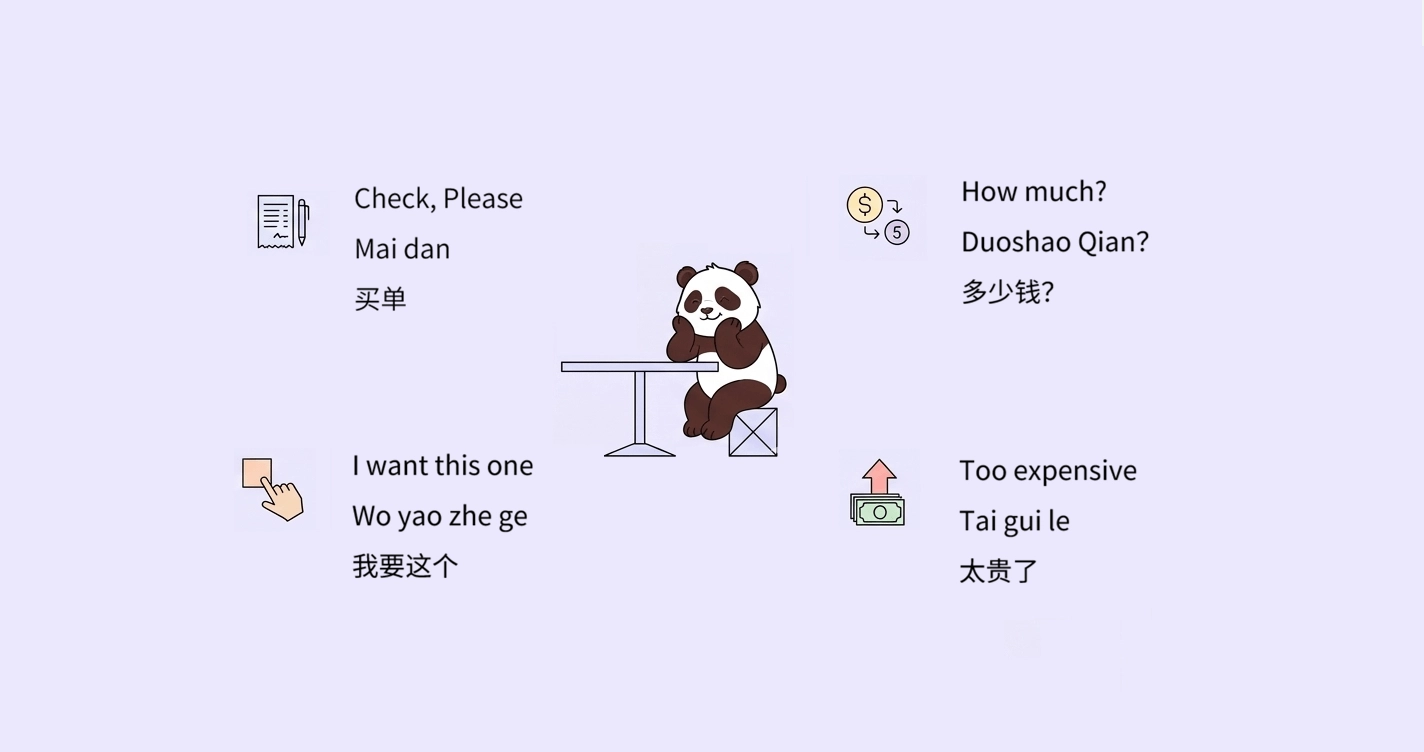
| Duō shǎo qián? | 多少钱? | dwaw shaow chyen | How much does this cost? |
| Tài guìle | 太贵了 | tie gway luh | Too expensive |
| Wǒ yào zhège | 我要这个 | waw yaow zhuh guh | I want this one |
| Mǎidān | 买单 | my dan | The bill, please |
| Nǎlǐ yǒu xǐshǒujiān? | 哪里有洗手间? | na lee yo shee show jyen | Where is the bathroom? |
| Wǒ yào qù… | 我要去… | waw yaow chew | I want to go to… (+ show address) |
| Zhèlǐ | 这里 | zhuh lee | Here (point to map) |
| Yīyuàn | 医院 | ee ywen | Hospital |
| Jǐngchá | 警察 | jing cha | Police |
| Jiùmìng! | 救命! | jyo ming | Help! (emergency) |
| Wǒ shì Měiguó/Yīngguó rén | 我是美国/英国人 | waw shir may/ying gwaw ren | I am American/British |
| Wǒ chī sù | 我吃素 | waw chir soo | I am vegetarian |
Greetings and Politeness
Nǐ hǎo (你好) – Hello
Works in any situation. Pronounced ‘nee how.’ For a more formal or respectful greeting, especially to older people, use Nín hǎo (您好) – pronounced ‘neen how.’
Xièxiè (谢谢) – Thank you
Use it constantly. After every transaction, every time someone helps you, every time a driver arrives. Chinese culture values courtesy and the effort of saying it in Mandarin, even badly, is always appreciated.
Duìbuqǐ (对不起) – Sorry / Excuse me
Use for both apologies and for getting someone’s attention (‘excuse me’). Pronounced ‘dway boo chee.’ In crowded situations – busy markets, narrow streets. This is very useful.
[Insert Image 1 Here: Two people having a conversation at a market stall in China. One person appears to be a foreign tourist, the other is a vendor. Both are smiling.]
Shopping and Payments
Duō shǎo qián? (多少钱?) – How much does this cost?
Point at the item, say this, and the vendor will either say the number or show you on a calculator or phone. One of the five most useful phrases in China.
Tài guìle (太贵了) – Too expensive
Shake your head, say this, and type a lower number into your phone calculator to counter-offer. Bargaining is standard at markets and small shops. Not appropriate at fixed-price stores or restaurants.
Wǒ yào zhège (我要这个) – I want this one
Point at the item and say this. Works for food, products, seats, anything. Simpler and clearer than attempting to describe something.
Mǎidān (买单) – The bill, please
Say this to a waiter when you want to pay. In many restaurants you can also simply mime writing on your hand. In QR-code restaurants, payment happens through WeChat Pay directly.
Getting Around
Wǒ yào qù… (我要去…) – I want to go to…
Follow this with showing your phone screen with the destination in Chinese. Do not try to pronounce a hotel or attraction name in Chinese – just say this phrase to indicate intent, then show the written address.
Nǎlǐ yǒu xǐshǒujiān? (哪里有洗手间?) – Where is the bathroom?
The most frequently needed phrase after ‘thank you.’ Often a pointing gesture is enough, but saying this phrase first gets immediate understanding and a pointed finger.
[Insert Image 2 Here: A person showing their phone screen to a taxi driver through the car window. The phone shows a Chinese address. The driver is looking at the screen.]
Emergencies
Jiùmìng! (救命!) – Help!
One syllable, easy to remember. Use in any emergency to attract attention.
Yīyuàn (医院) – Hospital
Show this on your phone or say it. Any taxi driver will understand and take you immediately.
Jǐngchá (警察) – Police
Two syllables: ‘jing cha.’ Say this if you need police assistance or need to find a police station.
Food and Dietary Needs
Wǒ chī sù (我吃素) – I am vegetarian
Literally ‘I eat vegetarian food.’ This is the clearest way to communicate a vegetarian diet. Note: in Chinese cooking, ‘vegetarian’ (素) often means no meat but may include fish broth or oyster sauce in some regions. If you need strict vegetarian, add: bùyào ròu, bùyào yú, bùyào jīdàn (不要肉,不要鱼,不要鸡蛋) — ‘no meat, no fish, no eggs.’
Pronunciation Tips
- X sounds like ‘sh’: Xièxiè = ‘shyeh shyeh’, not ‘zee-ay’
- Q sounds like ‘ch’: Qǐng = ‘ching’
- Zh sounds like ‘j’: Zhèlǐ = ‘juh lee’
- Use Baidu Translate to hear each phrase spoken – tap the speaker icon after entering the Chinese characters
Frequently Asked Questions
For your full communication toolkit, see our best translation apps for China. They handle everything these phrases cannot. For deeper cultural context, see our China etiquette guide.