
You show the taxi driver your hotel name on your phone. In English. He does not recognize it. You try to say the address. The tones are wrong. He types something into his GPS. You end up 3 km away from where you intended. This is avoidable. The fix: screenshot your hotel’s Chinese address from their website before leaving the room each day. Show the screen. Driver finds it. For map navigation in China: Amap guide.
Key Takeaways
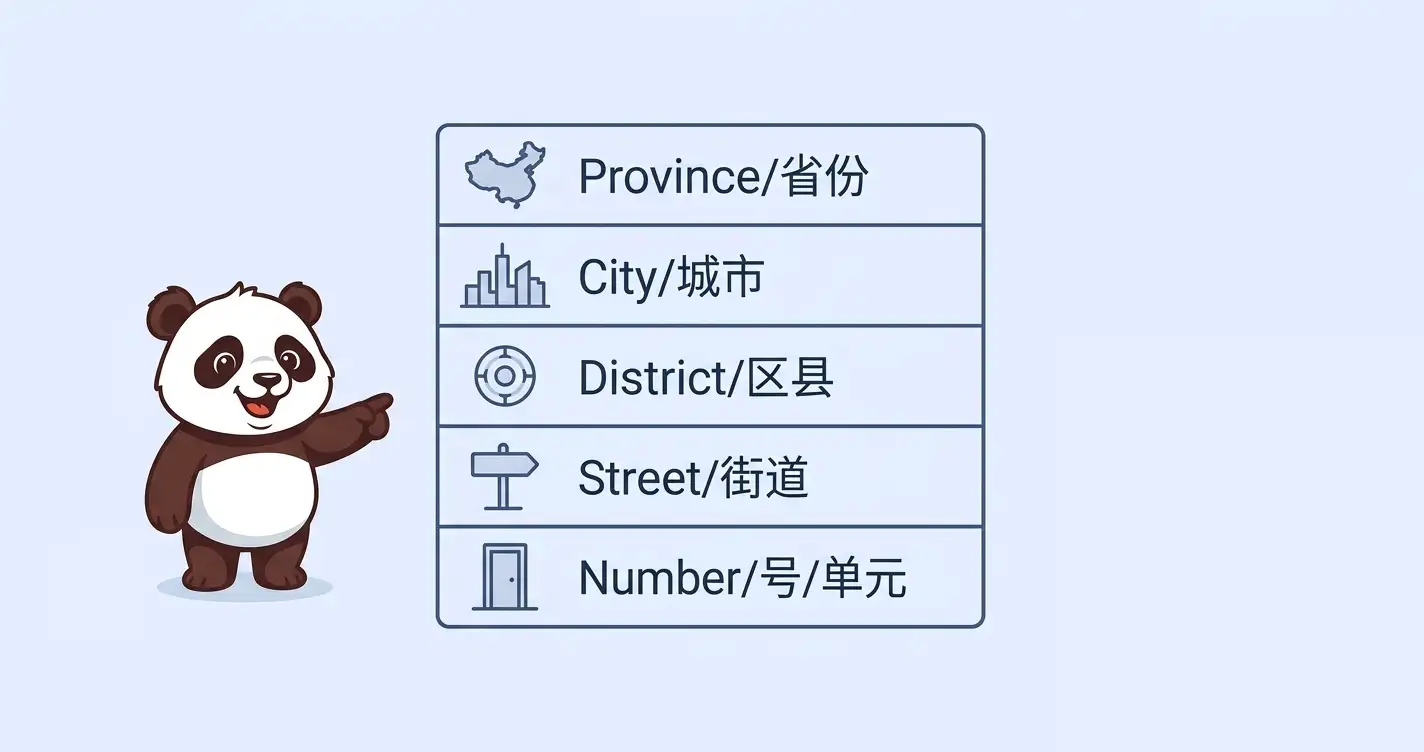
- Chinese addresses go largest to smallest: Province, City, District, Street, Number.
- Always show addresses in Chinese characters, not English transliteration.
- Screenshot your hotel’s Chinese address before leaving each day.
- DiDi auto-handles addresses. Search in English, it converts for the driver. Guide.
- Use Amap, not Google Maps. Map guide.
- For hutong / lane addresses: use a nearby landmark as backup.
The Address Format Explained
| Level | Chinese Term | Example |
| Province / Municipality | 省 (shěng) / 市 (shì) | 北京市 (Beijing City) |
| District | 区 (qū) | 朝阳区 (Chaoyang District) |
| Street | 路/街/道/巷 | 南京路 (Nanjing Road) |
| Number | 号 (hào) | 88号 (Number 88) |
| Building | 楼 (lóu) | 3号楼 (Building 3) |
| Floor | 层 (céng) | 5层 (5th Floor) |
| Unit | 室 (shì) | 301室 (Room 301) |
A full address reads: 上海市黄浦区南京路88号3号楼5层301室. Shanghai City / Huangpu District / Nanjing Road / Number 88 / Building 3 / 5th Floor / Room 301.
Five Address Terms Worth Knowing
- 路口 (lùkǒu): intersection. ‘南京路和西藏路路口’ = ‘Nanjing Road and Xizang Road intersection.’
- 地铁站 (dìtiě zhàn): metro station. The nearest station name is often more useful than a street address.
- 出口 (chūkǒu): exit. Metro stations have lettered exits. ‘B出口’ = Exit B.
- 对面 (duìmiàn): opposite or across from. ‘银行对面’ = ‘Opposite the bank.’
- 附近 (fùjìn): nearby. Useful for describing approximate location.
Your Daily Address Routine
Every morning before leaving the hotel: screenshot the hotel’s Chinese address and name (for the return journey), and confirm the Chinese address of your day’s main destination. Save both in your camera roll. This eliminates navigation confusion for the entire day.
Why DiDi Solves Most Address Problems
DiDi’s international version allows you to search destinations in English. The app converts your search to Chinese and sends the address to the driver in Chinese characters with the route already plotted. The driver sees the destination in Chinese. You see their route and ETA in English. No verbal address exchange needed at all. This is the most practical reason to use {url(‘didi-app-china’, ‘DiDi’)} over street taxis in Chinese cities. The Amap navigation app uses the same address database as DiDi for accuracy.
When Addresses Fail: The Landmark Method
In older neighborhoods (Beijing hutongs, Xi’an old city lanes, Chengdu temple areas), street numbers are unreliable. When this happens, use a nearby famous landmark: ‘雍和宫北门 (North Gate of Yonghegong Temple)’ or ‘鼓楼东边 (East of the Drum Tower)’. Drivers know landmarks far better than alley numbers. Show the landmark name in Chinese on your phone. Ask the hotel to write this for you before you check out.
Frequently Asked Questions
For DiDi setup: DiDi guide. For map navigation: Amap guide.