
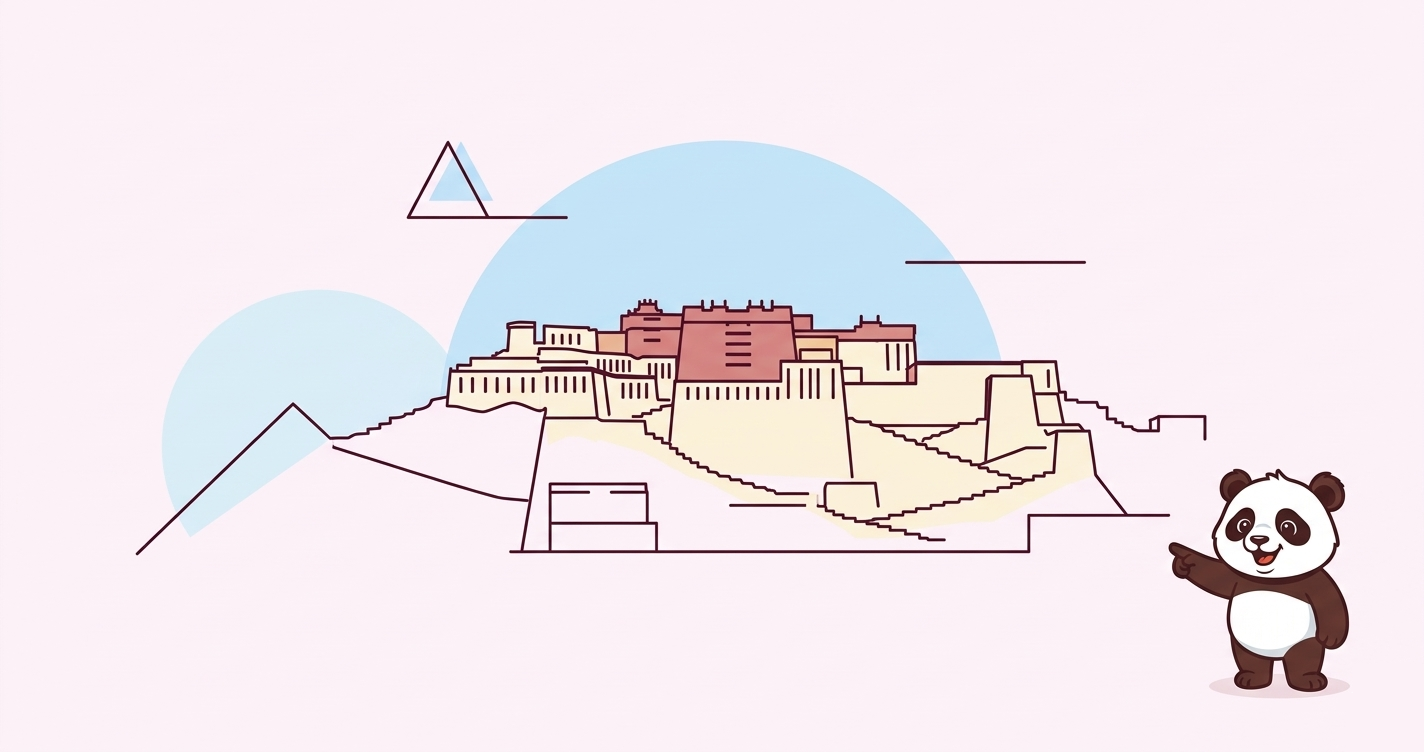
You fly from Chengdu to Lhasa at 7:30 AM. The Tibet Tourism Bureau manages all foreign entry permits to the region. The plane climbs over the clouds and then descends toward a plateau that stretches to every horizon. The Potala Palace appears below you, impossibly white and red, rising from a hill in the center of a city. You understand immediately why this place meant what it did.
At 3,700 metres, your first instinct on landing is to run toward it. Resist that. Give yourself two days before you attempt the stairs. For the Tibet permit required to be here: Tibet Travel Permit Guide. For altitude preparation: Altitude Sickness guide.
Key Takeaways
- Daily quota: 2,300 tickets. Books out in peak season (May to October). Book through your agency.
- Time limit inside: 1 hour. Strictly enforced.
- Do not visit on your first day. Acclimatize for 24 to 48 hours first.
- Walk slowly on the steps. Even fit travelers get breathless. There is no embarrassment in taking 20 steps and stopping.
- Jokhang Temple and Barkhor are equally essential. Do not skip them for the Potala.
- Photography restricted inside most halls. Check signs at each room entrance.
Planning Your Visit
Getting tickets
Your Tibet travel agency should book the Potala Palace ticket as part of your package. Confirm this explicitly before paying. If it is not included, have the agency add it. Tickets are non-transferable and tied to your passport number. The daily opening is usually 9:00 AM to noon and 3:00 PM to 6:00 PM, but check with your agency for current hours.
When to go
Morning session (9:00 AM to noon) is better for photography: cleaner light, the golden rooftops catch the sun, and the crowds are lower than the afternoon. Arrive 15 minutes early to join the queue at the entrance gate.
The climb
The main entrance from Shol Square involves a long gradual ramp followed by multiple steep stairways inside the palace. The total height gain from the base to the highest accessible terrace is around 100 metres. At 3,700 metres, this is equivalent to climbing harder than it sounds at sea level. Walk at the pace of the slowest person in your group. There is a bypass elevator for visitors with medical conditions.
Inside the Palace
The White Palace
Built in 1645 by the 5th Dalai Lama. Former administrative and residential quarters. The East and West Main Halls are the main spaces accessible to visitors. The 7th Dalai Lama’s throne and sleeping quarters can be viewed.
The Red Palace
The most sacred section. Contains the burial stupas of eight Dalai Lamas. The largest, dedicated to the 5th Dalai Lama, is covered in 3,700 kg of gold and embedded with jewels. The scale is astonishing. Photography is prohibited in most rooms of the Red Palace.
What Else to Do in Lhasa
| Site | What It Is | Time Needed |
| Jokhang Temple | The holiest temple in Tibetan Buddhism. Gold roof. Always full of pilgrims. | 1.5 to 2 hours |
| Barkhor Circuit | The pilgrim circuit around Jokhang. Best at dawn and dusk. | 45 minutes for one loop |
| Sera Monastery | Active monastery. Monk debate 3pm-5pm daily except Sunday. | 2 hours total |
| Norbulingka | Former Dalai Lama summer palace. Peaceful gardens. | 1.5 hours |
| Drepung Monastery | One of the world’s largest monasteries. Former home to 10,000 monks. | 2 to 3 hours |
Frequently Asked Questions
For the Tibet permit: Tibet Travel Permit Guide. For altitude sickness preparation: Altitude Sickness in China. For Tibet in a 3-week itinerary: 3-Week China Itinerary.