
You walk out of the Forbidden City’s north gate and climb Jingshan Hill. The UNESCO listed the Imperial Palace in 1987. Five minutes later you are standing at the Wanchun Pavilion, looking south over the entire Forbidden City: nine hundred rooms, gold-tiled roofs, red walls, the central axis of an empire. This view is free. Almost nobody is here. The tour groups are still inside.
This is how Beijing works when you know where to look: the famous things and then the places above and around them where you see the famous things properly. Here is how to do it. For a ready-built itinerary: 5-Day Beijing Itinerary.
Key Facts
| Item | Detail |
| Best months | Mid-October (clear, golden light). April to May (blossoms, mild). |
| Avoid | Golden Week Oct 1 to 7. July to August (hot, humid, air quality). |
| Stay in | Hutong area near Drum Tower or Nanluoguxiang. Not the CBD. |
| Getting around | Metro is excellent. Alipay transit QR code works everywhere. |
| Must book ahead | Forbidden City. Mutianyu Great Wall. Temple of Heaven. |
| Skip | Wangfujing snack street (tourist trap). Badaling Great Wall (overcrowded). |
The Essential Sites
Forbidden City (故宫)
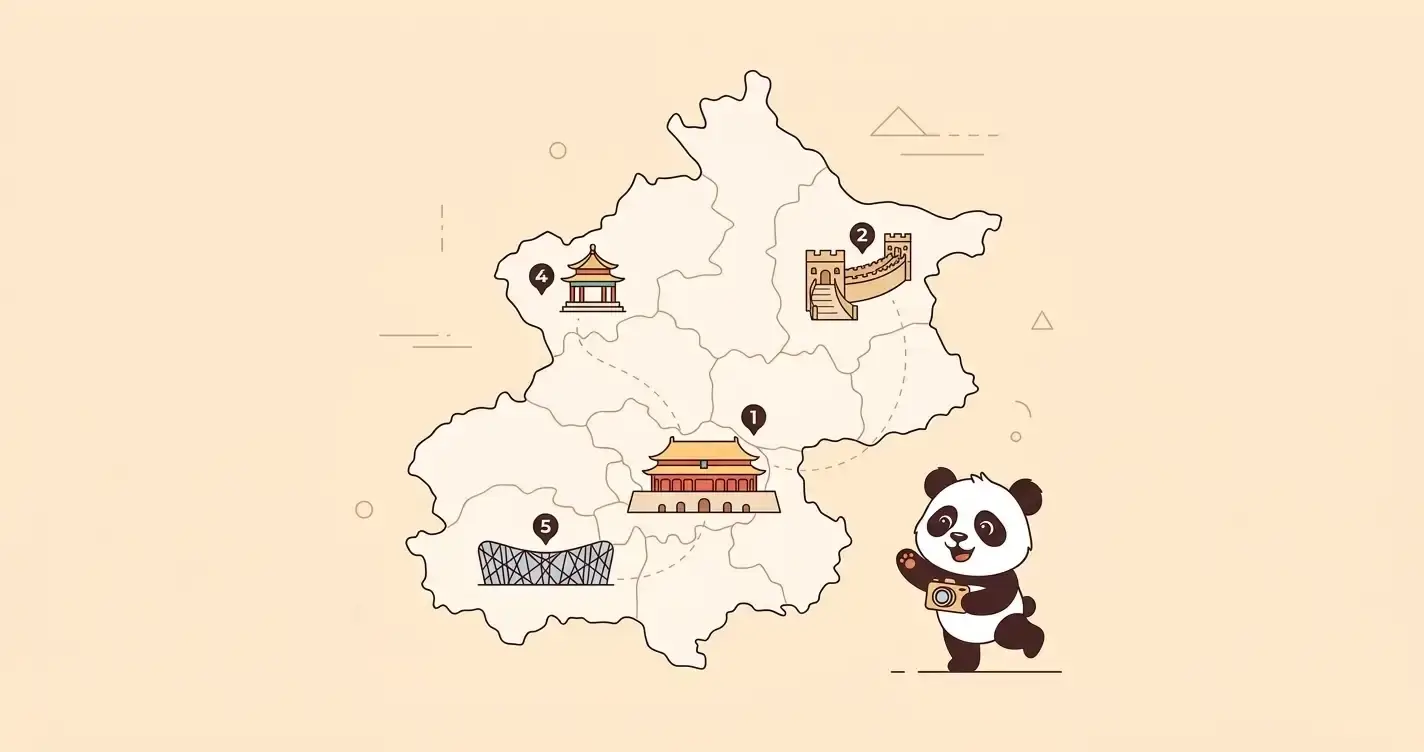
The world’s largest surviving palace complex. 9,999 rooms (by traditional count). Continuous imperial use from 1420 to 1912. Enter from Tiananmen Gate on the south side. Walk the central axis north: Gate of Supreme Harmony, Hall of Supreme Harmony, Hall of Middle Harmony, Hall of Preserving Harmony, Imperial Garden, north exit. Allow 2.5 to 3 hours. The side courts and less-visited eastern and western wings reward extra time. Book tickets via WeChat at least a week ahead in peak season. Full ticket guide: How to Book Forbidden City Tickets.
Jingshan Park (景山公园)
Directly north of the Forbidden City, across the moat. Entry ¥2. The hill was built from soil excavated during the Forbidden City’s construction. Climb to the Wanchun Pavilion at the summit for the best view of the Forbidden City’s roofline. This is the photograph. It is free, takes 15 minutes from the north exit of the Forbidden City, and most tour groups never come here.
Great Wall
Skip Badaling. The visitor numbers at Badaling on weekends are extraordinary in a bad way. Mutianyu, 90 minutes by car from the city, has the best-restored section, a cable car, and a toboggan descent. Jiankou (next valley over from Mutianyu) is wild and unrestored for experienced hikers. Simatai is open at night. Full comparison: Which Great Wall Section to Visit.
Temple of Heaven (天坛)
Arrive at 7am. The park is full of elderly Beijingers doing tai chi, ballroom dancing in groups, playing traditional instruments, and performing Beijing opera. This is as good as the temple itself and it is gone by 9am when tour groups start arriving. The Hall of Prayer for Good Harvests (circular, triple-roofed, no nails in its construction) is China’s most photographed building after the Forbidden City. Full guide: Temple of Heaven Guide.
Summer Palace (颐和园)
290 hectares of imperial garden northwest of the city. Kunming Lake takes up three-quarters of the site. The Long Corridor (728 metres of painted gallery along the north shore of the lake) is the main route. Climb Longevity Hill behind the corridor for views over the lake. Rent a boat for 30 minutes on the lake itself. Full guide: Summer Palace Guide.
Hutong neighborhoods
The grey-brick alleyways of Beijing are where the city lives at a human scale. Nanluoguxiang is the most famous: good for a first look but crowded from 10am. Better: the streets around Drum Tower (Gulou area), Beixinqiao, and the hutongs between Andingmen and the Bell Tower. Walk without a plan. Get lost. The hutongs are disappearing as Beijing modernizes. What you see is genuinely disappearing.
Eating in Beijing
| Food | What It Is | Where to Find It |
| Peking duck (北京烤鸭) | Roast duck with paper-thin skin. Eat with pancakes, scallion, cucumber, hoisin. | Siji Minfu (multiple locations). Better value than Da Dong. Guide: Best Peking Duck |
| Zha jiang mian (炸酱面) | Noodles with fermented soybean paste, minced pork, cucumber. The Beijing staple. | Any local noodle shop |
| Jianbing (煎饼) | Egg crepe with crispy wonton, scallion, chili paste. Breakfast street food. | Street carts 6:30 to 10am anywhere in the hutongs |
| Dou zhi (豆汁) | Fermented mung bean juice. Acquired taste. Divides opinion strongly. | Guijie (Ghost Street) area or Drum Tower markets |
| Skip | Wangfujing snack street (scorpions on sticks are for photos, not food). | Eat in a hutong restaurant instead |
Getting Around
Beijing’s metro is comprehensive and excellent. Line 1 runs east-west through the center (Tiananmen, Wangfujing). Line 2 is the inner ring loop. Line 4 connects Beijing South railway station (G-trains) to the hutong area and the Summer Palace. Pay with Alipay transit QR code or a rechargeable metro card (¥20 deposit, sold at all stations). Full subway guide: Beijing Subway Guide.
Frequently Asked Questions
For the full 5-day itinerary: 5-Day Beijing Itinerary. For Great Wall comparison: Great Wall Section Guide. For Forbidden City tickets: Booking guide.