
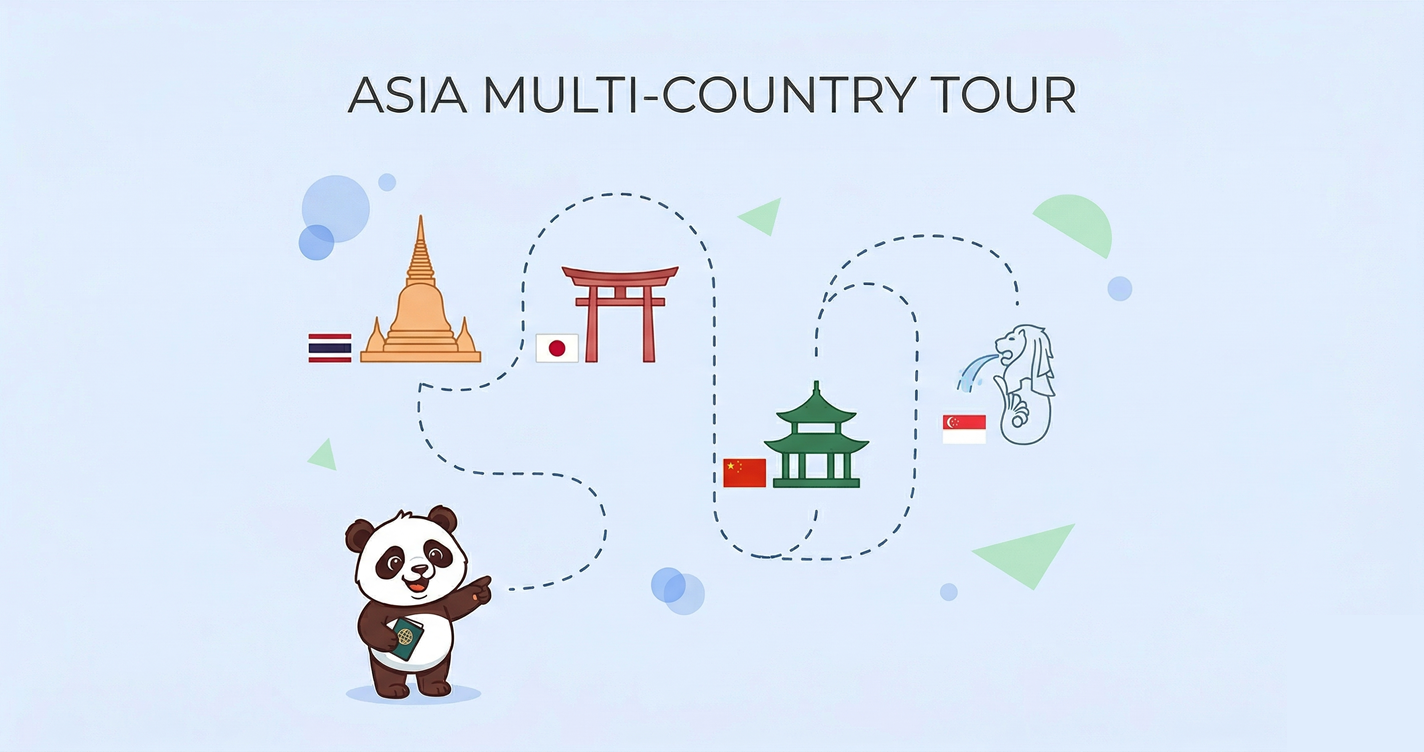
China sits in the middle of Northeast and Southeast Asia. IATA data shows China-Southeast Asia air routes among the fastest growing in Asia. It borders Vietnam, Laos, Myanmar, and shares short flights with Japan, South Korea, and Thailand. Most travelers think of China as a standalone destination that requires a dedicated trip. It can also be the anchor of a multi-country circuit that covers three distinct travel cultures in 3 weeks.
The 240-hour transit visa-free makes it cheaper and easier than ever before. Transit policy details: 240-Hour Transit Visa-Free.
The Most Practical Multi-Country Circuits
| Circuit | Duration | Route | Visa Complexity |
| China + Vietnam | 3 weeks | Shanghai/Beijing > Xi’an > Chengdu > Guilin > Hanoi > Hoi An > Ho Chi Minh City | China visa or transit visa-free. Vietnam e-visa ($25). |
| China + Japan | 3 weeks | Tokyo > Shanghai > Beijing > Xi’an > Shanghai > fly home | China visa or transit visa-free. Japan: visa-free for most Western passports. |
| China + Thailand | 3 weeks | Bangkok > fly Shanghai > Golden Triangle > fly Bangkok | China visa or transit visa-free. Thailand: 30-day visa-free. |
| China + South Korea | 2 weeks | Seoul > fly Beijing > Xi’an > Shanghai > fly Seoul | China transit visa-free if transiting. Korea: 90-day visa-free most passports. |
| Silk Road > Central Asia | 3 to 4 weeks | Xi’an > Dunhuang > Urumqi > Kashgar > overland to Kyrgyzstan/Kazakhstan | Complex. Requires research for each country visa. |
Using the Transit Visa-Free for a Multi-Country Circuit
The 240-hour transit visa-free is designed for exactly this kind of trip. If you are flying from one country to a third country and your layover is in China, you can spend up to 10 days in the Chinese city. For US and Canadian citizens, this means: fly into Beijing from Tokyo, spend 9 days in China, fly to Hanoi. No visa fee. The transit must go to a genuinely different destination (not your origin). Hong Kong and Macau count as separate regions for this purpose. Full details: 240-Hour Transit Visa-Free Guide.
China to Vietnam: The Border Crossing
By train (the atmospheric option)
The Hanoi to Nanning train crosses the border at Dong Dang on the Vietnamese side and Pingxiang on the Chinese side. Total journey: 12 to 14 hours including border processing. Departs Hanoi daily in the evening, arriving Nanning the next morning. The border section at 2am is slow (1 to 2 hours of passport checks and bag inspections). The scenery through the karst hills of Guangxi is excellent. Worth it once.
By flight (the efficient option)
Shanghai to Hanoi: 3.5 hours. Guangzhou to Hanoi: 2 hours. Multiple daily departures on Air China, China Southern, Vietnam Airlines, and budget carriers. If you are short on time, fly.
China to Japan: The Short Hop
Japan and China are geographically close but culturally extreme opposites. Many travelers find the contrast between them the most striking part of the trip. Shanghai to Tokyo Narita: 3 hours. Shanghai to Osaka Kansai: 1.5 hours. Shanghai to Tokyo is also served by the Suzhou/Osaka ferry (overnight, 45 hours, much slower but an experience).
Japan is visa-free for citizens of most Western countries. Japan’s tourist infrastructure is different from China’s: more English, higher prices, more individual travel. The contrast after 2 weeks in China is jarring and interesting.
Practical Notes for Multi-Country Trips
- Book outbound China flight before your transit visa-free starts. You need to show an onward ticket from China at immigration.
- Alipay does not work internationally. Have a standard Visa or Mastercard for non-China spending.
- VPN considerations: set it up in China before crossing into countries where VPN access works differently.
- Currency: do not convert unused Chinese yuan at airport exchange desks. Rates are poor. Spend it or keep for your next China visit.
Frequently Asked Questions
For transit visa-free details: 240-Hour Transit Visa-Free.