
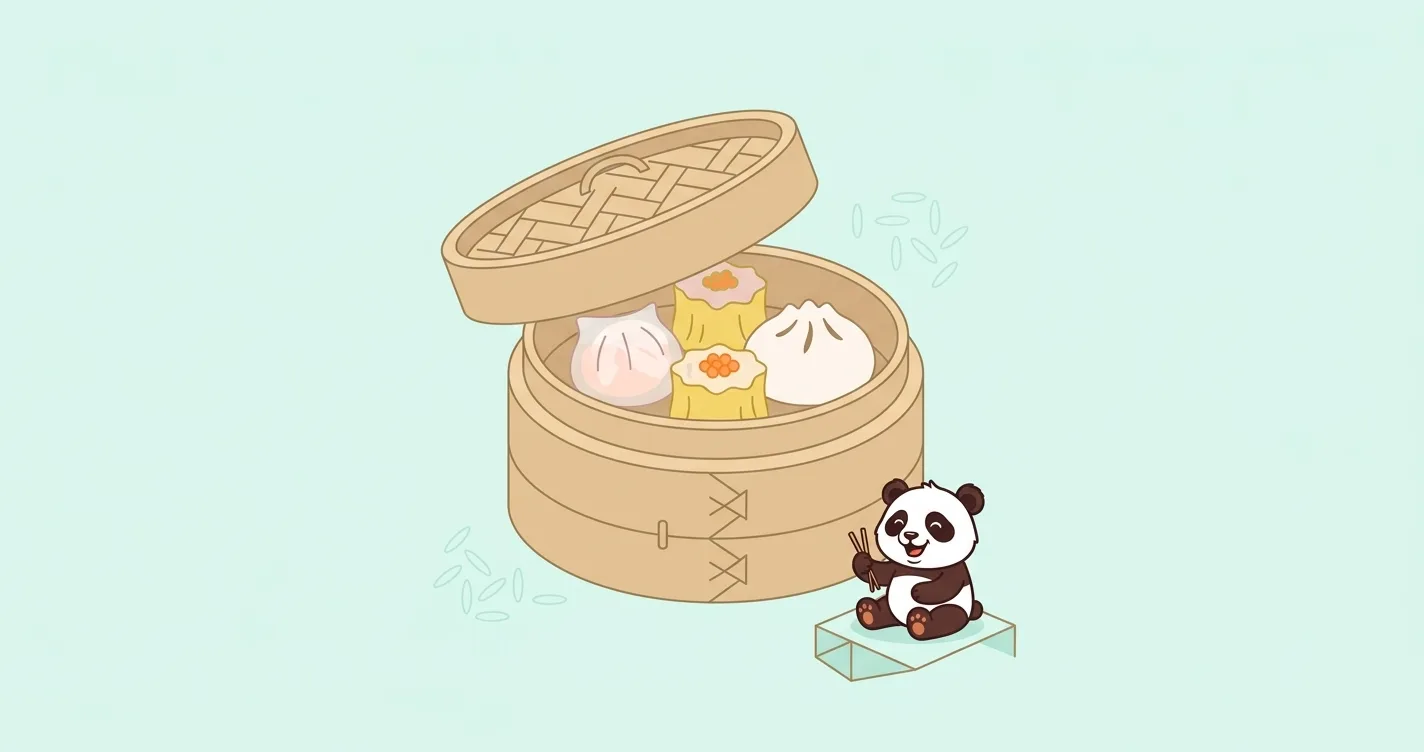
The trolley arrives. A woman lifts a bamboo lid to show you the contents. You have no idea what it is. You nod anyway. It turns out to be chicken feet in black bean sauce. They are excellent. This is how most first dim sum experiences go. This guide tells you what to nod at and what to point at before the trolley reaches you. For the full food context: Ultimate Chinese Food Guide.
The Ten Dishes to Know
| Chinese Name | What It Is | Notes |
| 虾饺 (har gow) | Steamed shrimp dumpling in translucent rice wrapper | The benchmark dish. If the wrapper tears before you eat it, the restaurant is mediocre. |
| 烧卖 (siu mai) | Open-topped steamed dumpling with pork and shrimp | Topped with a dot of carrot or roe. One of the first to order. |
| 叉烧包 (char siu bao) | Steamed bun filled with BBQ pork | Also comes baked. Both are good. Order one of each. |
| 肠粉 (cheung fun) | Wide rice noodle roll filled with shrimp, pork, or beef | Served with sweet soy sauce. Silky, soft, excellent. |
| 萝卜糕 (lo bak go) | Pan-fried turnip cake, savory, slightly crispy | Mild flavor. Good entry point for cautious eaters. |
| 蛋挞 (dan tat) | Egg custard tart in a flaky or shortcrust shell | Order toward the end. The best dessert in dim sum. |
| 凤爪 (feng zhao) | Braised and steamed chicken feet in black bean sauce | Gelatinous and complex. An acquired taste but a genuine classic. |
| 糯米鸡 (lo mai gai) | Sticky rice with pork and mushroom in lotus leaf, steamed | Rich and filling. Order midway through. |
| 春卷 (chun juan) | Fried spring roll with vegetable and pork filling | Crispy, fast to eat, usually the first thing gone. |
| 马拉糕 (ma lai go) | Steamed brown sugar sponge cake | Sweet, light, good between savory dishes. |
How the Meal Works
Step 1: Order tea
Before any food order, the server asks which tea you want. Pu-erh (普洱) is the classic dim sum pairing: earthy, cuts through oil, good for the whole meal. Jasmine (茉莉) is lighter and floral. Chrysanthemum (菊花) is very mild. If in doubt, pu-erh.
Step 2: Order food
At traditional dim sum restaurants, servers wheel trolleys past your table. Point at what you want. They stamp or tick your receipt. At modern dim sum restaurants, a QR code at the table opens a photo menu and you order digitally. Either works.
Step 3: The tea ritual
When tea is poured for you, tap two slightly bent fingers on the table (index and middle finger). This is the Cantonese thank-you gesture for tea pouring. It is understood everywhere in China. When your pot needs refilling, lift or tilt the lid.
Step 4: Eat in any order
There is no strict sequence. A loose convention: steamed dumplings first (har gow, siu mai), then noodle and rice dishes (cheung fun, lo mai gai), finish with something sweet (egg tart, sponge cake).
Where to Eat Dim Sum
Guangzhou is the origin and the best. Hong Kong is equally strong. Outside Guangdong, quality and variety decline. Shanghai has good Cantonese restaurants in Jing’an and Huangpu districts. Beijing has dim sum but it is a shadow of the Guangzhou experience.
The Michelin Guide covers the top dim sum restaurants in Guangzhou and Hong Kong if you want specific recommendations for the best available.
Frequently Asked Questions
For the full Chinese food guide, see Ultimate Chinese Food Guide. For ordering strategies, see How to Order Without English Menus.