
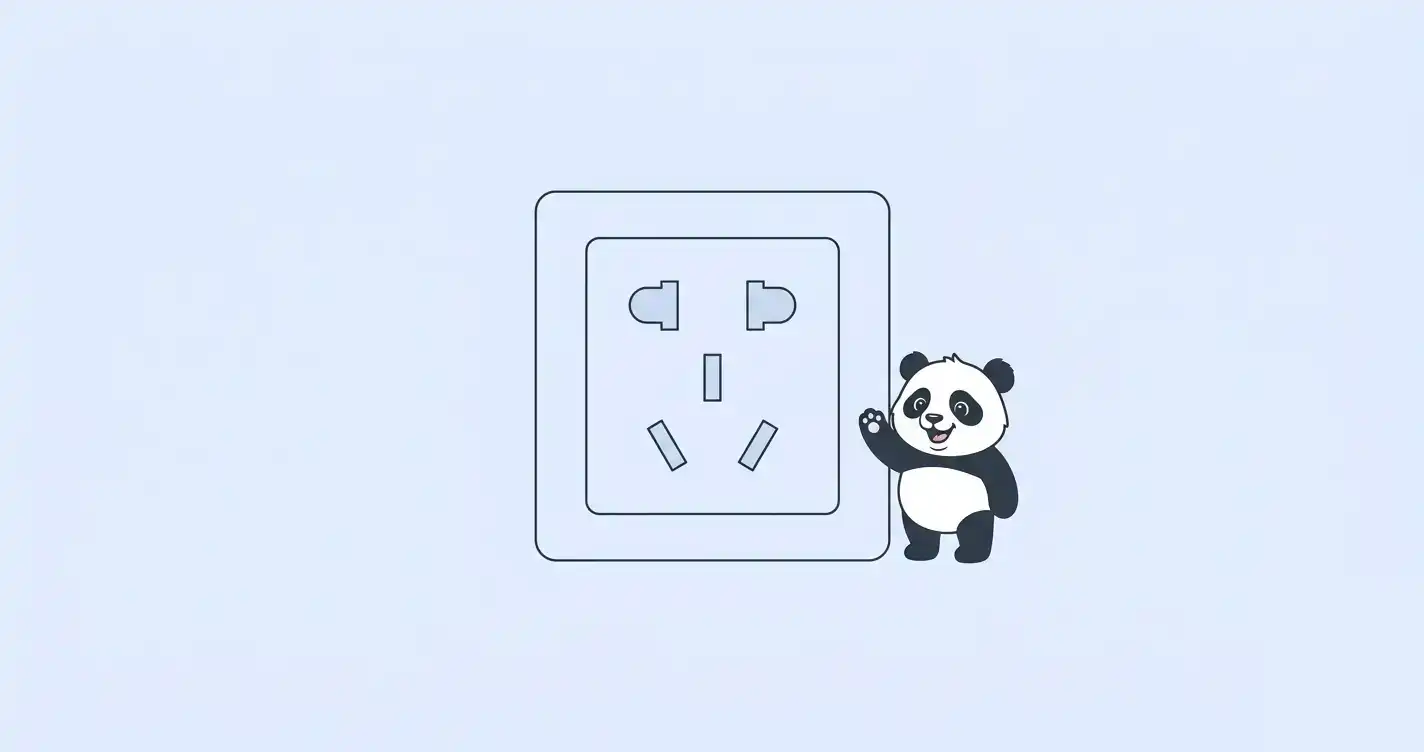
Before you plug anything into a Chinese wall socket, do one thing: check the label on your device. Not the cable. The charger brick, the power supply, the device itself. If it says ‘100-240V’, you are fine anywhere in the world. If it says ‘110V only’ or ‘120V only’, plugging it into China’s 220V supply will damage it. Your phone charger is almost certainly fine. Your hair dryer is the most common casualty. Take 60 seconds now and you will not have this problem.
Key Takeaways
- China is 220V. Check every device label for ‘100-240V’ (safe) or ‘110V only’ (not safe).
- Phone chargers, laptops, cameras: almost always dual-voltage. Fine in China.
- Hair dryers, curling irons: often 110V only. Buy cheap replacements in China.
- US plugs (Type A): fit most Chinese sockets without an adapter.
- UK and European plugs: need a universal adapter.
- Hotels: most 3-star and above have built-in USB ports at the bed. You may not need the adapter at all.
China’s Sockets: What You Are Dealing With
China uses two socket types, both on the same 220V supply. Type A (two flat parallel pins, same as the US) and Type I (two angled pins, same as Australia). Most Chinese sockets accept both. This means US travelers often plug in without any adapter at all. UK, European, and South African plugs need a universal adapter. The full international socket reference: IEC World Plugs database.
| Your Home Plug | Type | Fits China Sockets? |
| US / Canada / Japan | Type A (2 flat parallel pins) | Yes, usually. Bring a universal adapter as backup. |
| Australia / New Zealand | Type I (2-3 angled pins) | Yes, fits directly. |
| UK / Ireland / Hong Kong | Type G (3 rectangular pins) | No. Needs an adapter. |
| Europe (most countries) | Type C / E / F (2 round pins) | No. Needs an adapter. |
| South Africa | Type M (3 round pins) | No. Needs an adapter. |
The Voltage Check: 60 Seconds That Matters
Find the label on each device you are packing. Look for the voltage specification. It is usually printed in small text near the power input or on the bottom of the device.
| What the Label Says | What It Means | Safe in China? |
| 100-240V ~ 50/60Hz | Dual voltage. Works everywhere. | Yes. Just use an adapter for the socket shape. |
| 110-240V | Dual voltage. | Yes. |
| 110V ~ 60Hz only | Single voltage for North America. | No. Will be damaged at 220V. |
| 120V ~ 60Hz only | Single voltage for North America. | No. Will be damaged at 220V. |
| No label / label worn off | Cannot verify. | Do not risk it. Leave it home. |
The Specific Devices to Check
Fine in China (almost always dual-voltage)
- Smartphone chargers (Apple, Samsung, any modern brand)
- Laptop power bricks (MacBook, Dell, HP, Lenovo)
- Camera battery chargers
- Tablet chargers
- CPAP / APAP machines (most modern travel versions are dual-voltage, but check your specific model)
Check before packing
- Hair dryers: many home models are 110V only. Travel-specific dual-voltage models exist and are worth buying.
- Curling irons and straighteners: same situation as hair dryers.
- Electric shavers: most modern travel shavers are dual-voltage. Older models may not be.
- Electric toothbrushes: the charging dock is usually dual-voltage. Check the label.
Hotels and Built-In USB Ports
Most Chinese hotels at three stars and above have USB-A ports built into the bedside panel or desk. Newer hotels include USB-C. For phone charging, you often do not need your adapter at all inside the room. The adapter matters for laptops, cameras, and any device that needs a standard wall plug. Check the room when you arrive before unpacking everything.
What Adapter to Buy
A universal travel adapter with USB-A and USB-C ports built in is the only travel adapter you ever need. It accepts plugs from every country and fits sockets from every country. You plug it into the Chinese socket (Type A or Type I), and it gives you a universal outlet plus USB charging. Brands like Ceptics and TESSAN make reliable ones for under $15. One with at least one USB-C port is worth the extra dollar. Buy it before you fly. For the full packing list, see Packing for China.
Frequently Asked Questions
For the full packing list, see Packing for China. For power bank rules on Chinese flights, see China Power Bank Rules.