
You book second class on the Beijing to Shanghai G-train. Your seat is wide, the tray table is solid, there is a power socket at your armrest. The train runs at 350 km/h and arrives 4.5 hours later. You spent ¥553 instead of ¥933 for first class. You feel no meaningful difference. That is the honest answer to the class question on most Chinese routes under 5 hours: second class is fine. For the full rail guide: China High-Speed Rail Guide.
Key Takeaways
- Second class: 5-across, power sockets, tray table. Comfortable for up to 5 hours.
- First class: 4-across, more recline, quieter. Worth it for 5+ hour journeys.
- Business class: near-flat recline on some trains. For 6+ hour routes or if you need to sleep.
- Price difference: first class is 50 to 80% more than second. Business is 3 to 4x.
- For routes under 3 hours: the class difference barely matters.
- Book on Trip.com or 12306: 12306 guide.
Class Comparison
| Class | Chinese | Layout | Price vs 2nd | Best Journey Length |
| Second class | 二等座 | 5-across (3+2). Moderate recline. | Baseline | Any. Great value under 5h. |
| First class | 一等座 | 4-across (2+2). Better recline. | +50% to +80% | 5h+. Noticeably better comfort. |
| Business class | 商务座 | 3-across (1+2). Near-flat on some trains. | +200% to +300% | 6h+. Overnight use. |
| Observation car (some G-trains) | 观光车厢 | Panoramic windows. Standing/sitting. | Same as 2nd | Any route with scenery. |
Second Class: What You Actually Get
Second class on China’s G-trains is the workhorse of the network. Seats are wider than typical economy airline seats. Each seat has a fold-down tray table, a power socket (Type A/I), a reading light, and a small pocket for belongings. The seat reclines slightly (around 10 to 15 degrees). The 3+2 layout means middle seats exist in the three-seat row. If you are traveling solo, request an aisle seat (靠走道, kào zǒudào) or window seat (靠窗, kào chuāng) when booking. According to the China State Railway Group, G-trains maintain an on-time rate above 95%.
When second class is the right call
- Any journey under 5 hours. The extra cost of first class rarely justifies itself.
- When traveling with a group booking adjacent seats. Block-booking is easier in second class.
- Budget travel. The comfort is genuine and the savings are real.
First Class: The Quiet Upgrade
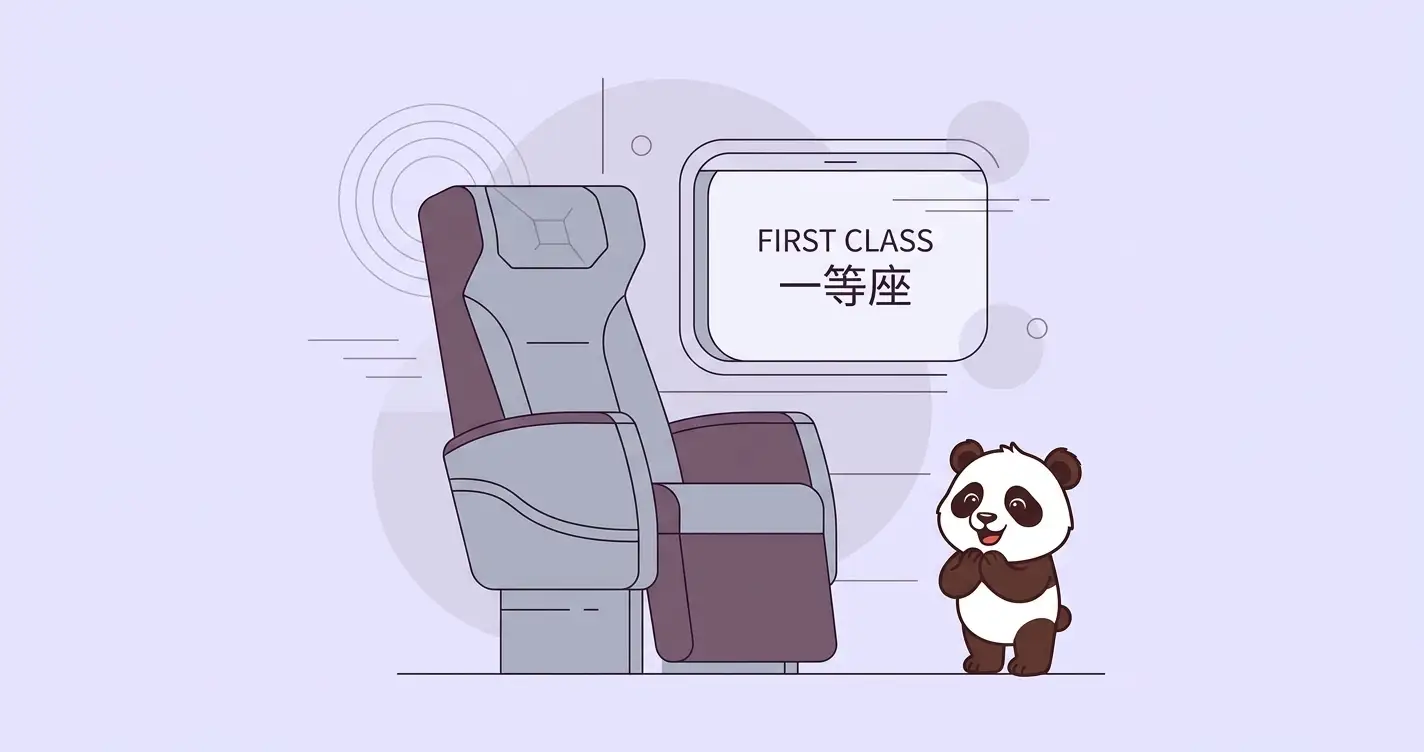
First class gives you two meaningful improvements over second: a 2+2 layout (no middle seat ever) and a wider seat with better recline. The carriage is noticeably quieter. No families with young children in second class will drift in. On a 7-hour journey, that matters. On a 2-hour journey, you will barely notice the difference.
| Route | 2nd Class Price | 1st Class Price | Worth Upgrading? |
| Beijing to Shanghai | ¥553 | ¥933 | Only for 5+ hour travelers who want comfort |
| Beijing to Xi’an | ¥464 | ¥742 | Borderline. 4.5 hours. |
| Shanghai to Hangzhou | ¥73 | ¥118 | No. 45 minutes. |
| Xi’an to Chengdu | ¥290 | ¥466 | Yes. 3.5h through mountain scenery. |
| Guangzhou to Beijing (overnight) | ¥862 | ¥1,285 | Consider business class or overnight sleeper instead. |
Business Class: When It Makes Sense
Business class on G-trains has seats that recline to near-horizontal on most models. Individual footrests, larger tray tables, 1+2 layout. On some newer Fuxing-class trains (复兴号), the business seat goes fully flat. For overnight journeys or long-haul routes (6 hours+), this replaces the need for a separate sleeper train. At 3 to 4 times the second class price, it is a premium. Worth it if you have a business expense account or are covering a 10-hour route.
Seat Selection Tips
- Window seat code: A or F in second class. A or D in first class.
- Aisle seat: C in second class (3-seat row). B or C in first class.
- Avoid: the middle seat in second class (B position in the 3-seat row) on long journeys.
- Scenic routes: Xi’an to Chengdu has mountain views. Beijing to Shanghai is mostly flat.
- Quiet carriage: first class carriages are generally quieter.
Frequently Asked Questions
For booking either class: China High-Speed Rail Guide and How to Buy on 12306.