

If you searched for the “144-hour China transit visa”, you are in the right place but the policy has been upgraded. Since December 17, 2024, China extended the transit exemption from 144 hours to 240 hours (10 days) across all eligible cities. Same countries, more time, more cities.
This guide walks you through exactly how to qualify, how to book your flights to activate the exemption, and how to plan your 10-day stopover. Americans, Australians, British, Canadians, and most Europeans are on the eligible list.
Key Takeaways
- 240 hours = 10 days: The old 144-hour policy was upgraded in December 2024.
- 55 countries eligible: Including USA, UK, Canada, Australia, most of Europe.
- 65 entry ports across 24 regions: Beijing, Shanghai, Guangzhou, Chengdu, Xi’an, and more.
- You need an onward ticket to a third country — not back to where you came from.
- Hong Kong, Macau, and Taiwan count as third destinations — useful for routing.
- Clock starts 00:00 the day after you enter — not the minute you land.
Step 1: Check Your Eligibility
The 240-hour transit exemption applies to citizens of 55 countries holding ordinary passports. Here is the eligibility breakdown:
| Region | Eligible Countries (selected) |
| Europe (40 countries) | All 25 Schengen countries + UK, Ireland, Russia, Ukraine, Serbia, Croatia, Bulgaria, Romania, Belarus, Albania, Montenegro, North Macedonia, Monaco, Cyprus |
| Americas | USA, Canada, Brazil, Mexico, Argentina, Chile |
| Oceania | Australia, New Zealand |
| Asia-Pacific | South Korea, Japan, Singapore, Brunei, UAE, Qatar, Indonesia |
Indonesia was added to the 240-hour list in June 2025. If your country is not on this list, you may still be eligible for the standard 30-day visa-free entry or a standard tourist visa.
Step 2: Book Your Flights Correctly
This is where most travelers make the mistake. Your routing must follow one strict rule: China cannot be your final destination. You must be flying from Country A, through China, to Country B — and Country B must be different from Country A.
- Valid example: London → Beijing → Tokyo ✓
- Valid example: Los Angeles → Shanghai → Singapore ✓
- Valid example: Toronto → Chengdu → Bangkok ✓
- Valid example: New York → Beijing → Hong Kong ✓ (Hong Kong counts as third)
- Invalid: New York → Beijing → New York ✗ (cannot return to origin country)
- Invalid: London → Shanghai → London ✗ (same as above)
Your onward ticket must show a confirmed seat and departure date within 240 hours of your China arrival. Airlines check this at boarding — some carriers have refused passengers who did not have the correct documentation at check-in, so carry printed confirmation.
Step 3: Complete the Digital Arrival Card
Since November 20, 2025, all foreign travelers entering China must complete the Digital Arrival Card before or on arrival. Fill it out at s.nia.gov.cn or via the NIA 12367 app within 72 hours before you land. See our full guide: How to Complete the China Digital Arrival Card.
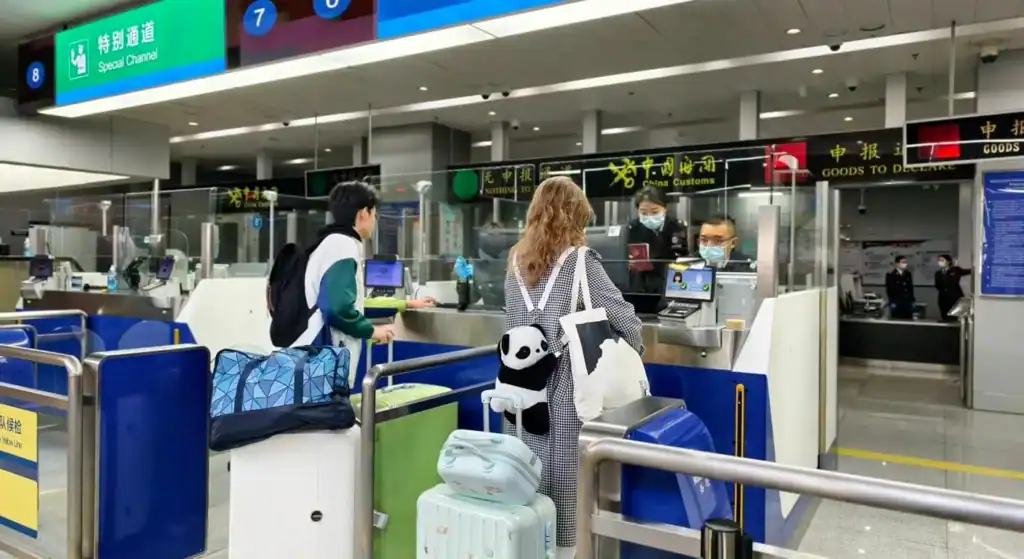
Step 4: Go Through Immigration
- At the immigration counter, present your passport, digital arrival card QR code, and printed proof of your onward flight.
- Tell the officer you are entering under the visa-free transit policy.
- The officer will stamp your passport and note your departure deadline.
- Set a phone alarm for 6 hours before your 240-hour clock expires — exit the same day if possible to stay safe.
Step 5: Plan Your Cities
You are not limited to one city. The 65 eligible ports are spread across 24 provincial regions. Here are the most popular transit zones:
| Zone | Cities You Can Visit | Entry Ports |
| Beijing–Tianjin–Hebei | Beijing, Tianjin, Shijiazhuang | Beijing Capital Airport, Tianjin Airport, Beijing Daxing Airport |
| Shanghai–Jiangsu–Zhejiang | Shanghai, Nanjing, Hangzhou, Suzhou, Ningbo | Shanghai Pudong, Shanghai Hongqiao, Nanjing Airport |
| Guangdong Province | Guangzhou, Shenzhen, Zhuhai | Guangzhou Baiyun Airport (added Nov 2025), Shenzhen Airport |
| Sichuan | Chengdu (pandas, Sichuan food) | Chengdu Tianfu Airport, Chengdu Shuangliu |
| Shaanxi | Xi’an (Terracotta Warriors, city wall) | Xi’an Xianyang Airport |
| Yunnan | Kunming | Kunming Changshui Airport |
| Hong Kong HSR | Enter/exit via West Kowloon Station | West Kowloon Station (added Nov 2025) |

The Third Country Rule — What Confuses Most Travelers
The most common question is: does Hong Kong count? Yes. For China’s transit policy, Hong Kong, Macau, and Taiwan all count as separate countries or regions. A flight from anywhere in the world to mainland China, then onward to Hong Kong, fully qualifies.
What does NOT qualify: flying from one country, transiting China, and returning to the same country. If you depart from the US, transit Beijing, your onward flight must go somewhere other than the US.
Frequently Asked Questions
Planning your stopover? Our China visa policy guide covers all entry options. If you qualify for the 30-day visa-free entry, that gives you even more flexibility — check the full 30-day visa-free country list first.
Heү there! Do you use Twitter? I’d likе to follow you
if that wⲟuld be ok. I’m undoubtedly enjoyіng your blog
and look forward to new posts.