
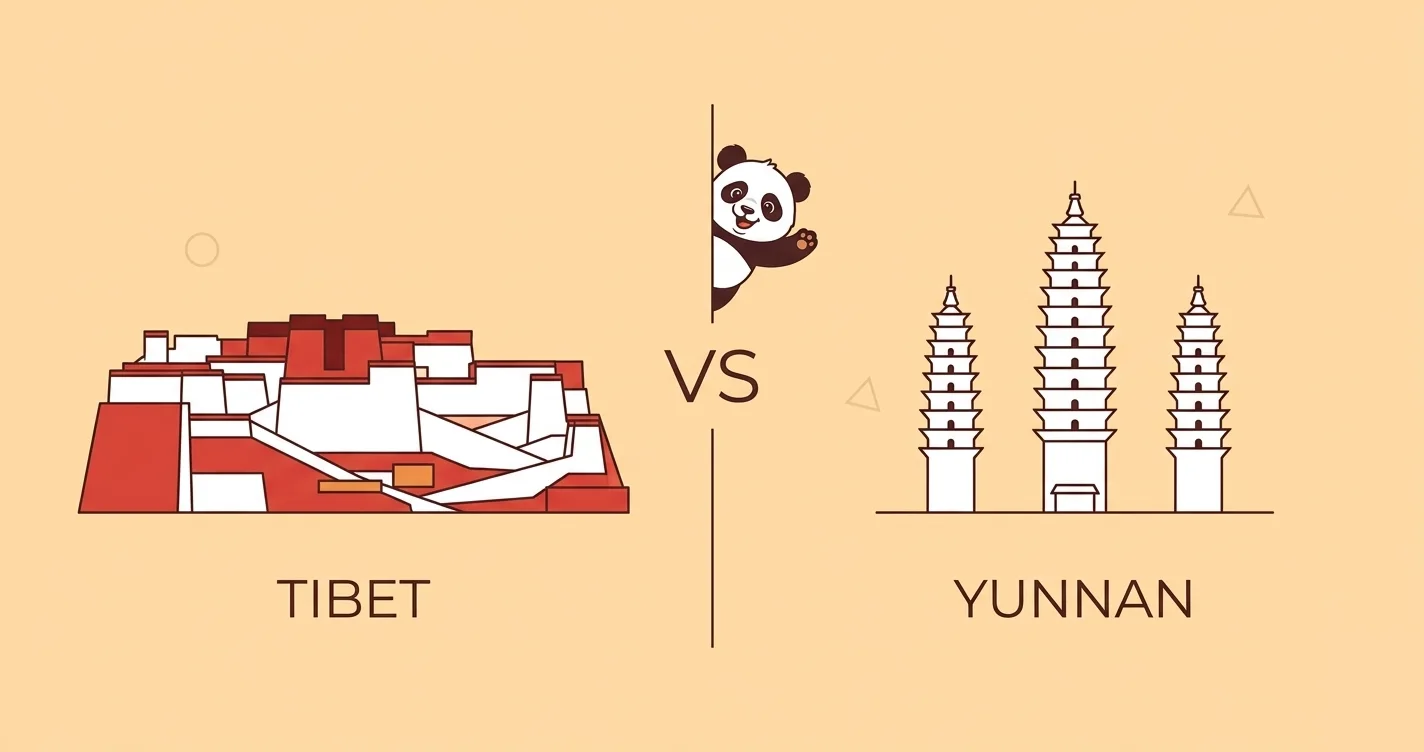
Tibet and Yunnan are both in southwest China and both draw travelers seeking dramatic landscapes and minority cultures. The difference is access. Yunnan is an ordinary province: no special permit, accessible to independent travelers, domestically connected by cheap flights and G-train. Tibet requires a Tibet Tourism Bureau (TTB) permit, a licensed Tibetan tour agency, and cannot be visited independently. Here is the full comparison. For the full comparisons hub: China City Comparisons.
Side-by-Side Comparison
| Factor | Tibet | Yunnan |
| Permit required | Yes. TTB permit through licensed agency. | No. Standard China visa. |
| Independent travel | Not permitted. | Yes. Full independent travel possible. |
| Main altitude | Lhasa: 3,650m. Namtso Lake: 4,718m. | Lijiang: 2,400m. Shangri-La: 3,200m. |
| Altitude sickness risk | High. Acclimatization mandatory. | Low to moderate. Some adaptation needed for Shangri-La. |
| Best for | Potala Palace. Tibetan Buddhism. Plateau landscapes. Everest base camp. | Lijiang old town. Tiger Leaping Gorge. Dali. Minority culture variety. |
| Ease of visit | Complex. Requires agency. Group or guided only. | Easy. One of China’s most foreigner-friendly provinces. |
| Cost | Higher than most China destinations due to permit and mandatory agency fees. | Affordable. Standard China travel prices. |
| Season | April to October (best). Winter possible but cold and some routes closed. | March to October. Rainy season June to August. |
Tibet: What You Get
The Potala Palace in Lhasa is one of the most visually extraordinary buildings in the world: a 13-storey whitewashed fortress on a clifftop at 3,700 metres. The Jokhang Temple is the spiritual heart of Tibetan Buddhism, surrounded by prostrating pilgrims at all hours. The Tibetan plateau extends for hundreds of kilometres in all directions: sky and grassland and yak and monastery.
The altitude, the scale, and the religious intensity of the place create an experience that most visitors describe as one of the most moving they have had. But you must arrange it properly.
Yunnan: What You Get
Yunnan is China’s most scenically diverse province: tropical rainforest in Xishuangbanna, alpine scenery above Shangri-La, the UNESCO old town of Lijiang, and the active Bai minority culture of Dali. The Tiger Leaping Gorge (虎跳峡) is one of the deepest gorges in the world and a 2-day hike through it is one of the best long walks in China. Yunnan is also where China’s best coffee is grown (Pu’er region) and where pu-erh tea originates. Full Yunnan planning: Yunnan Itinerary.
The Shangri-La Middle Option
If you want Tibetan culture without the permit complexity: Shangri-La (香格里拉) in northwest Yunnan. The city was renamed from Zhongdian specifically to attract tourism. The Songzanlin Monastery (松赞林寺), 5 km north of the city, is one of the most important Tibetan Buddhist monasteries outside Tibet itself: 600 monks, Baroque-style main hall, genuine religious activity. At 3,200m, there is some altitude effect but it is manageable. No permit. No mandatory guide.
Frequently Asked Questions
For Tibet permit details: Tibet Travel Permit Guide. For Yunnan planning: Yunnan Itinerary. For altitude guidance: Altitude Sickness in China. For the full comparisons hub: China City Comparisons.