
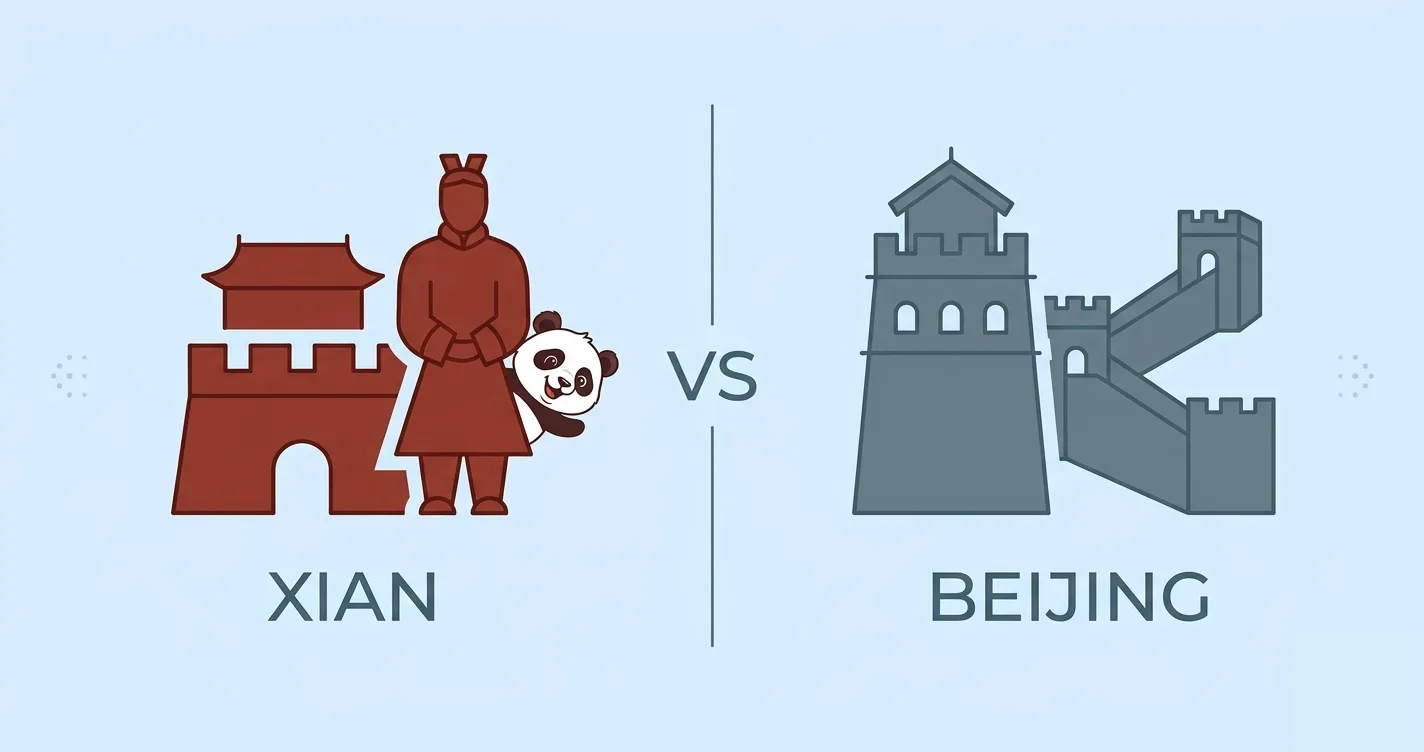
Both cities claim to be the greatest ancient capital in China. Both have reasonable claims. The difference is the era. Xi’an (called Chang’an during its peak) was the eastern terminus of the Silk Road and the capital of the Han and Tang dynasties. At its Tang dynasty peak it was one of the largest cities in the world. Beijing’s peak came later, as the Ming and Qing capital from 1420 onwards, producing the Forbidden City, the Temple of Heaven, and the imperial garden networks.
In the UNESCO World Heritage system, both cities have multiple listings. For Xi’an: Xian Travel Guide. For Beijing: Beijing Travel Guide.
Side-by-Side Comparison
| Factor | Xi’an | Beijing |
| Historical era | Han and Tang dynasties (206 BC to 907 AD). Silk Road era. | Yuan, Ming, and Qing dynasties (1271 to 1912 AD). Late imperial era. |
| Signature attraction | Terracotta Warriors (210 BC). The army is extraordinary. | Forbidden City (1420 AD). The world’s largest palace complex. |
| City wall | 14 km intact Ming wall. Cycleable. One of China’s best. | No surviving city wall within the old city perimeter. |
| Food | Muslim Quarter: roujiamo, paomo, biang biang noodles. | Peking duck, Shandong cuisine, hutong jianbing street food. |
| Day trips | Hua Shan, Pingyao (2.5h G-train). | Great Wall (multiple sections 2h from city). |
| Size | Smaller, more manageable. Old city intact. | Vast. Requires more planning and transit time. |
| International visitors | Less crowded than Beijing overall. | One of China’s most visited cities. Major sites busy. |
| Getting there | G-train from Beijing: 4.5 to 5.5h. Or fly. | International hub. Connected everywhere. |
The Case for Xi’an
Xi’an deserves more visits than it gets. The Terracotta Warriors at 8:30am before the tour buses arrive are one of the most remarkable archaeological experiences available anywhere in the world. The Muslim Quarter at 9pm is the best street food market in China. The city wall is cycleable in under 2 hours on a rented bicycle. Hua Shan (40 min G-train) is one of China’s most dramatic mountains. The city is smaller and more manageable than Beijing.
For travelers who find the scale of Beijing overwhelming, Xi’an is the easier and often more satisfying ancient capital.
The Case for Beijing
Beijing is where the scale of Chinese imperial ambition is most legible. The Forbidden City’s 980 buildings spread across 72 hectares. The Temple of Heaven’s geometry (the circular shape representing heaven, the square enclosure representing earth) is visible even from street level. Jingshan Park gives you the best view over the Forbidden City rooftops for free. The hutong neighborhoods north of the palace are some of the most atmospheric urban streets in Asia.
And the Great Wall, 2 hours north of the city, is in a category of experience entirely its own.
The Honest Recommendation
First-time China visitor: Beijing. The total experience is richer and larger. History-focused traveler interested in the Silk Road and Chinese antiquity: Xi’an. The Terracotta Warriors alone justify a dedicated trip. Travelers with 10+ days: both, with Xi’an taking 2 to 3 nights between Beijing and Chengdu.
Frequently Asked Questions
For the full comparisons hub: China City Comparisons. For a full itinerary: China Itinerary guide.