
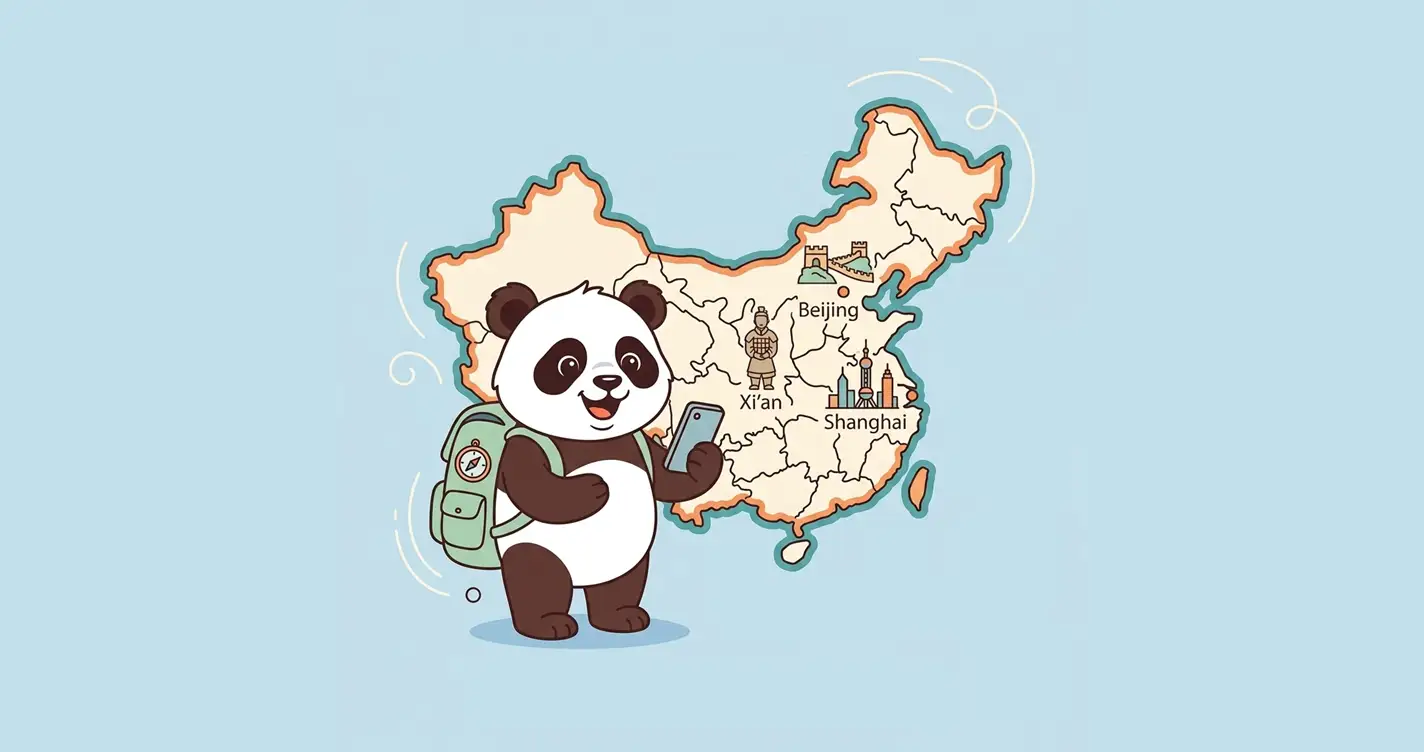
Solo travel in China is more straightforward than most Western travelers expect. The CNN Travel has repeatedly ranked China among the world’s most solo-travel-friendly countries. and more challenging than optimistic travel bloggers suggest. The country is safe. The language barrier is real. The payment infrastructure for foreigners has improved but still requires setup.
The rewards are significant: eating where you want, moving at your pace, making unexpected connections, and experiencing China on your own terms rather than through a group lens. Here is what to prepare for. For safety context: Is China Safe?.
The Real Challenges for Solo Travelers
Language
The language barrier in China is genuine. Major tourist sites have English signage. Train stations and metro systems have English labels. But restaurants without picture menus, conversations with taxi drivers, navigating a visa extension, or explaining a dietary restriction: these require either Google Translate (voice), Pleco (translation app), or a willingness to point and gesture.
Download Pleco and Google Translate offline before you arrive. The translation apps are genuinely useful. They do not replace Chinese but they make solo navigation possible.
Payment
China has moved significantly toward cashless payment. Many local restaurants, market stalls, and small shops prefer or only accept Alipay or WeChat Pay. The 2024 update allowing foreigners to link international cards to Alipay has made this much more manageable. Set up Alipay before you go. Carry some cash (CNY200 to CNY400) for places that have not yet updated. Full guide: Alipay for Foreigners.
Booking things in China
Many popular attractions now require advance booking: Huangshan mountain hotels, Zhangjiajie timed entry, Gulangyu ferry tickets. Some of these are much easier to book with a Chinese phone number and a Chinese bank card. A Airalo eSIM gives you a Chinese data number that helps with SMS verification. Trip.com solves most of the English-language booking gap.
The Solo Travel Infrastructure
| Resource | What It Solves | Setup Required |
| Pleco app | Offline Chinese-English dictionary and character scanner | Download before arrival |
| Google Translate (offline Chinese) | Real-time voice and photo translation | Download offline language pack before arrival |
| Airalo eSIM | Chinese data + number for SMS verification | Purchase before departure |
| Alipay (foreigner version) | Cashless payment throughout China | Set up before arrival with foreign card |
| Trip.com | English-language booking of trains, flights, hotels | Download app, register with email |
| DiDi | Ride-hailing across China | Download, register, link Alipay or card |
The Best Solo Routes
Solo travel in China works best as a point-to-point route on the high-speed rail network. The classic solo circuit: Beijing (3 nights), Xi’an (2 nights), Chengdu (3 nights), Guilin/Yangshuo (3 nights), Shanghai (2 nights). All connected by G-train. Total distance: roughly 5,000 km. Total rail cost: approximately CNY1,500 to CNY2,000 (£170 to £220). The route covers imperial history, Sichuan food culture, karst landscape, and modern China in a logical geographic arc without backtracking.
Solo Tour Options
If you want the social element of group travel without giving up the solo identity: G Adventures Solo-ish tours run with exclusively solo travelers. Intrepid’s high proportion of solo travelers (50%+) means most groups are de facto solo-traveler gatherings. Both operators do not charge single supplements. Full comparison: Best China Tours Reviewed.
Frequently Asked Questions
For female solo travel: Solo Female Travel China. For safety: Is China Safe?. For budget: China Daily Budget.