
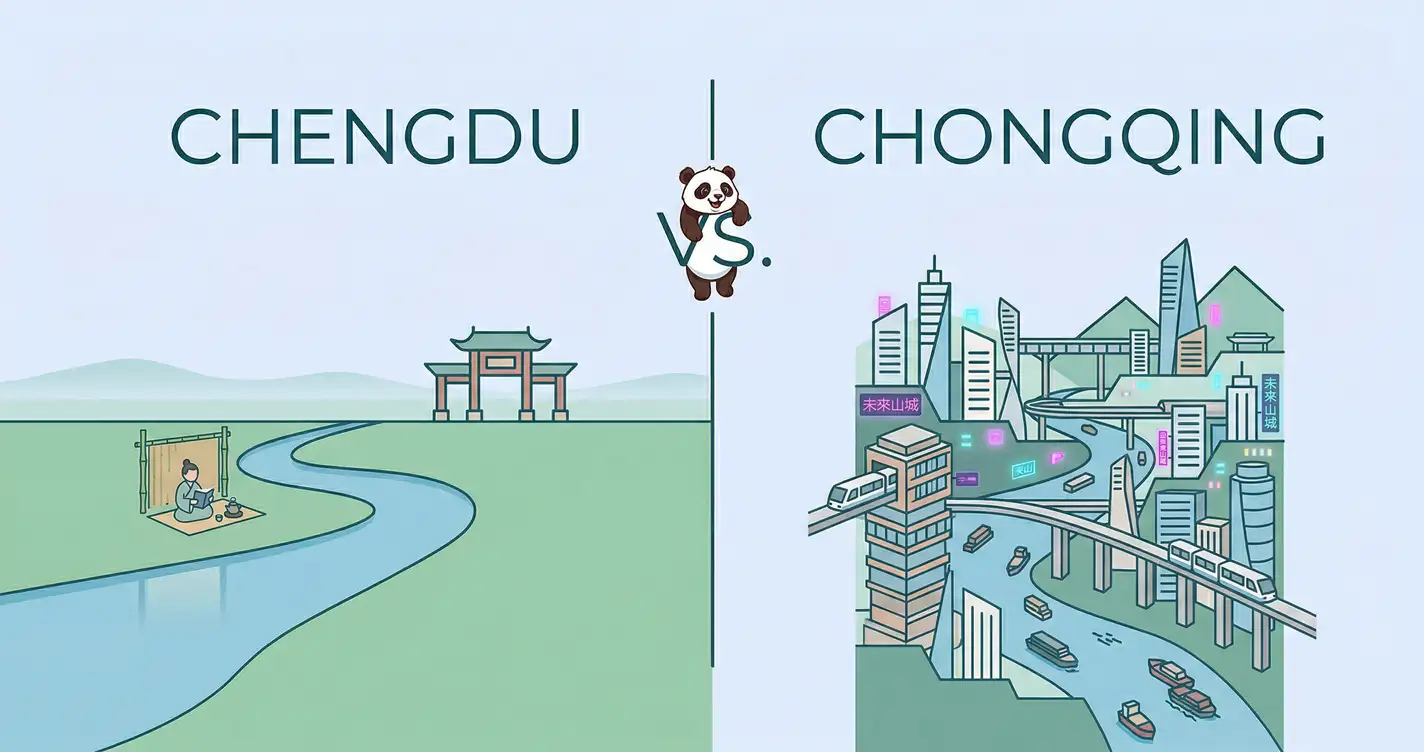
Both Chengdu and Chongqing are mega-cities in southwest China. Both are in Sichuan province (technically Chongqing is its own municipality, but culturally Sichuan). Both have excellent hotpot. Beyond that, they are quite different cities with different characters, different strengths, and different reasons to visit. Here is the honest comparison. For the full Chengdu guide: Chengdu Travel Guide.
The Fundamental Difference
Chengdu is flat. The Chengdu Plain stretches in every direction, and the city spreads outward on a grid. Walking is easy. Navigation is straightforward. The pace is slow by Chinese city standards. People sit in teahouses for entire afternoons. Chongqing is built on and between mountains at the confluence of the Yangtze and Jialing rivers.
It is vertical in a way that defies easy orientation. Metro lines go underground, emerge above ground, and rise above buildings in the same journey. Highways thread through the upper floors of skyscrapers. At night, the city stacks up the hillsides in layers of red neon. It is one of the most visually dramatic cities in China.
Side-by-Side Comparison
| Factor | Chengdu | Chongqing |
| Terrain | Flat. Easy to navigate. | Vertical. Built on cliffs and hills. Disorienting at first. |
| Pace | Relaxed. China’s most liveable city. | Busy, chaotic, energetic. |
| Hotpot | Canola oil base (lighter). Most restaurants serve Chongqing-style anyway. | Beef tallow base. The original, richest, spiciest version. |
| Pandas | Giant Panda Base: 80+ pandas. World’s best panda experience. | Chongqing Zoo has pandas but far fewer. |
| Instagram value | People’s Park teahouse, Kuanzhai Alley. | Hongyadong at night, elevated highways through buildings, river confluence. |
| Day trips | Leshan, Emei Shan, Jiuzhaigou, Bifengxia pandas. | Three Gorges area, Dazu Rock Carvings. |
| Food beyond hotpot | Canola oil cooking, Dan Dan noodles, Zhong dumplings, Fuqi feipian. | Mouth-watering chicken (口水鸡), spicy crayfish, spicy noodles. |
| Ease of travel | Metro is excellent. Flat city. Easy to walk. | Metro is confusing at first due to terrain. Many escalators. |
| Recommended stay | 3 to 4 nights minimum. | 2 to 3 nights if combined with Chengdu. |
The Hotpot Question
Here is something most travel guides do not explain clearly: Chengdu hotpot and Chongqing hotpot are genuinely different things, and the name of the city you are in does not automatically tell you which style you are eating. Most restaurants in Chengdu serve Chongqing-style beef tallow hotpot because it is the more popular style. Authentic Chengdu-style canola oil hotpot requires seeking it out. In Chongqing itself, you are definitely getting Chongqing-style: beef tallow broth, heavy, rich, and so intensely spiced that first-timers often underestimate it.
The first bite in a real Chongqing hotpot restaurant is a physical experience. Order the split pot (鸳鸯锅) if you are uncertain: one side spicy, one side mild broth. For the full Chengdu hotpot guide with specific restaurant recommendations: Sichuan Hotpot Guide.
Chongqing: The City at a Glance
Why people go
Chongqing is genuinely unlike any other Chinese city. The visual drama of a city built on cliffs, with highways running between buildings and entire neighborhoods stacked on vertical terrain, creates a landscape that looks like science fiction. At night, with the Yangtze illuminated below and the hillside buildings lit red and gold above, the effect is extraordinary.
Hongyadong (洪崖洞)
The most photographed site in Chongqing: 18 floors of traditional Stilted Diaojiao Lou buildings built into the cliff above the Jialing River. The interior is a commercial complex with restaurants and shops. The exterior, lit up at night, is the image on every Chongqing travel post. Visit the riverside walkway below for the full view, not just from the top.
The Yangtze and Jialing rivers
Chongqing sits at the confluence of the Yangtze and Jialing rivers. A cruise on either river at night, with the illuminated cityscape rising on both banks, is one of the most impressive urban river experiences in China. The contrast between the ancient geography of the rivers and the futuristic density of the city above them is uniquely Chongqing.
Dazu Rock Carvings
2 hours from Chongqing by high-speed train or car, the Dazu Rock Carvings are a collection of Tang and Song dynasty Buddhist, Taoist, and Confucian rock carvings in an extraordinary state of preservation. The UNESCO World Heritage Site listing covers six major carving sites. The Beishan and Baoding Mountain sites are the most impressive. Often overlooked by visitors focused on Chengdu and Chongqing city attractions. Worth a dedicated half-day.
Which Should You Visit?
Both, if you have the time. The G-train between Chengdu and Chongqing takes 1 hour 10 minutes and costs around ¥100. Most travelers base in Chengdu (better connectivity, pandas, easier navigation) and do a 1 to 2 night Chongqing add-on. If you genuinely only have time for one: Chengdu for the pandas, relaxed pace, and better tourist infrastructure. Chongqing if you specifically want dramatic urban photography and the original beef tallow hotpot experience.
Frequently Asked Questions
For the full Chengdu guide: Chengdu Travel Guide. For Chengdu hotpot: Sichuan Hotpot Guide.