
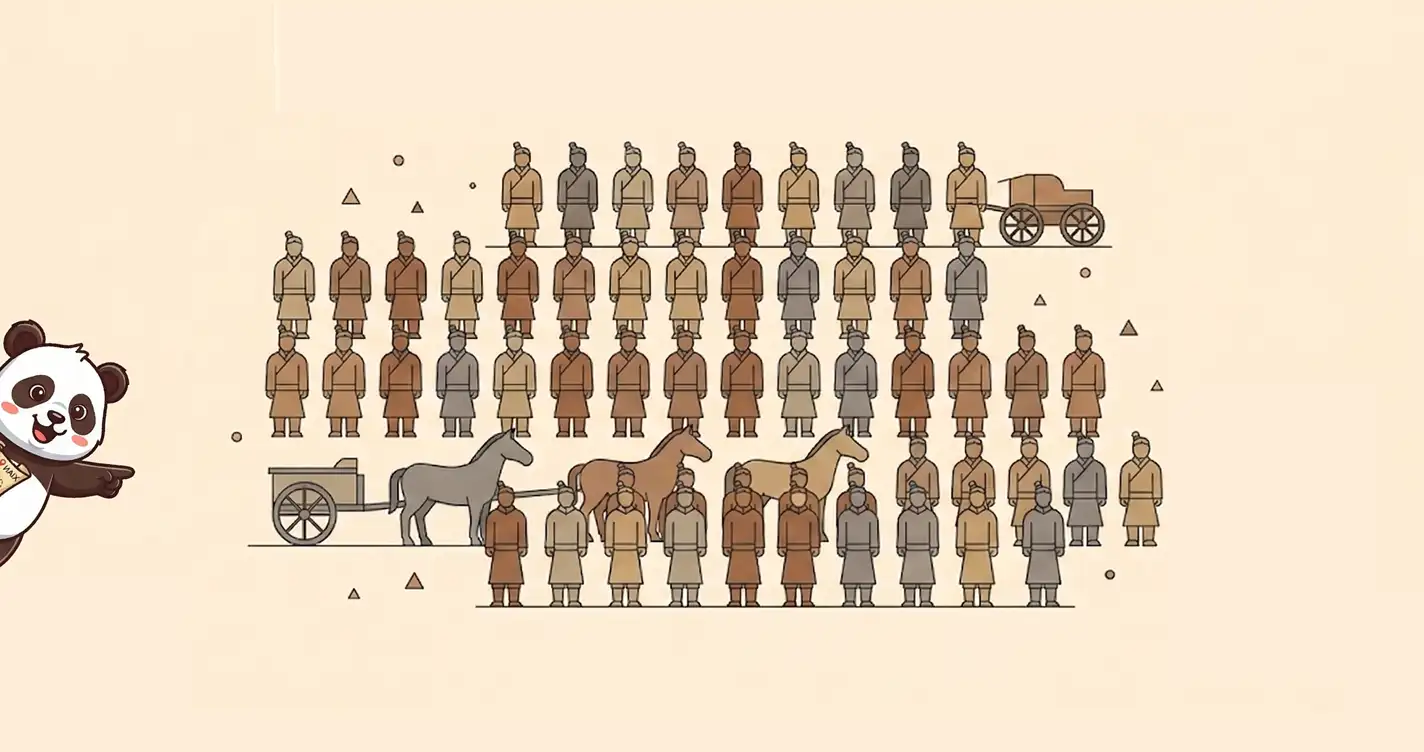
In 1974, a farmer named Yang Zhifa was digging a well. His spade hit a terracotta head. What followed was one of the most significant archaeological discoveries of the 20th century: three pits containing over 8,000 life-sized clay soldiers, each with an individually modeled face, arranged in military formation to guard China’s first emperor in the afterlife.
The UNESCO World Heritage Committee called it one of the greatest discoveries of the century. For Xi’an context: Xian Travel Guide.
Key Takeaways
- Arrive at 8:30 AM opening. Pit 1 before 10am is manageable. After 10am it is very crowded.
- Get the audio guide (¥30). Without it the significance is not immediately clear.
- Visit all three pits plus the Bronze Chariot Museum. Budget 3 to 4 hours.
- DiDi from city: 40 min, ¥60 to ¥80. DiDi guide.
- No two faces are the same. Each warrior was individually modeled. Look closely.
- Book ahead for peak season (summer, Golden Week, May Day).
Getting There
By DiDi
Type ‘兵马俑’ or ‘Terracotta Warriors Museum’ in DiDi. Drop-off at the main entrance on Qinling Avenue. 40 to 50 minutes from Bell Tower area. Book your return DiDi before entering the site. DiDi setup guide.
By public transport
Metro Line 1 from Zhonglou (Bell Tower) to Fangzhicheng (20 min). Exit A, walk 200m to Tourist Bus 5 stop. Bus to museum: 30 min, ¥15. Total: 90 min.
The Three Pits
Pit 1: The main formation
The largest pit. Over 6,000 warriors arranged in 11 columns facing east. Walk the full perimeter of the hall, not just the central corridor. The rear sections show ongoing excavation with warriors still emerging from the earth.
Pit 2: The cavalry pit
Contains a mixed force of cavalry, archers, and infantry. The most important section: warriors deliberately left unexcavated to preserve their original paint. Fully excavated warriors lose their color within minutes of air exposure.
Pit 3: The command structure
Smallest pit. Interpreted as the command center with senior officers. The bronze weapons found here are among the finest in the complex.
Bronze Chariot Museum
A separate building southwest of the pits. Two bronze horse-drawn carriages from 210 BC at half scale of actual chariots. The metalwork is extraordinary: parasols, articulated bronze reins, armor plating, detailed harnesses. Most visitors skip this entirely. That is the wrong decision.
Frequently Asked Questions
For Xi’an overview: Xian Travel Guide. For DiDi: DiDi guide.