
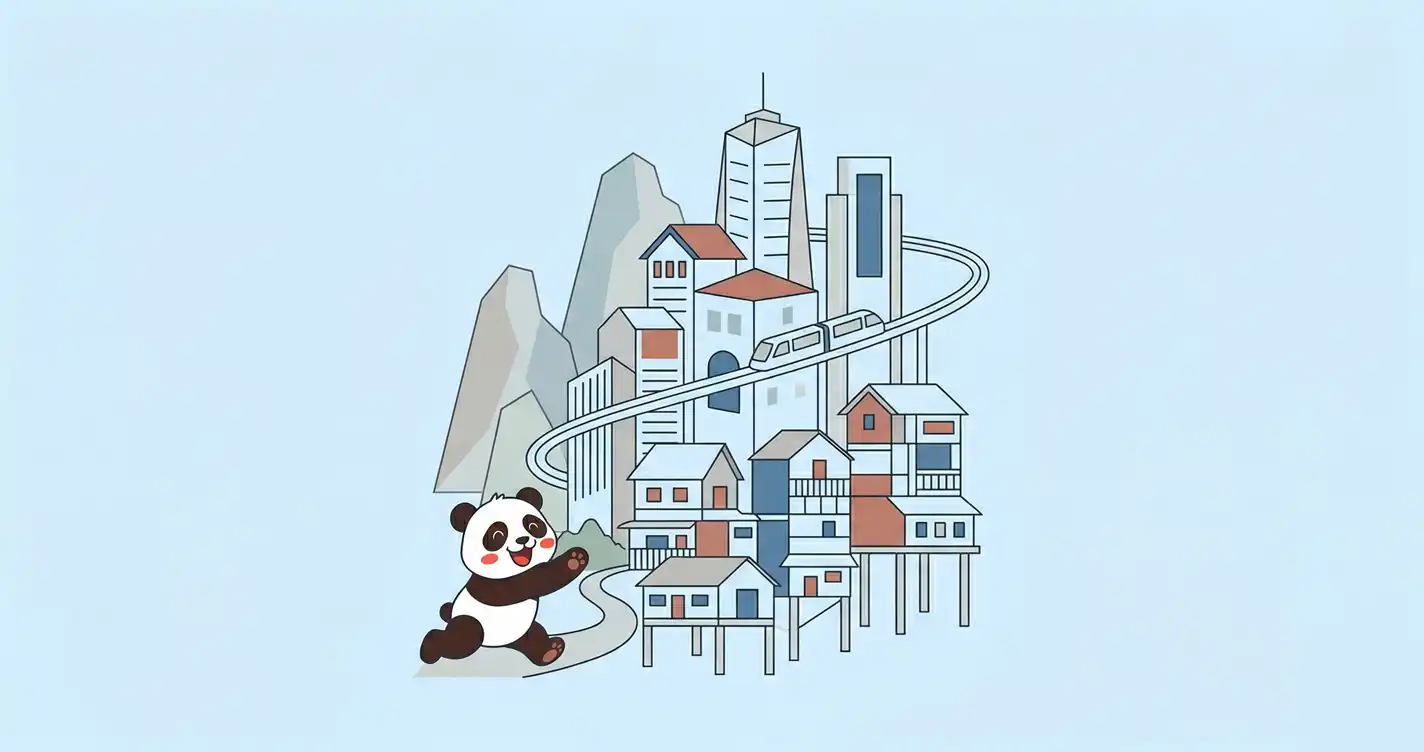
You are at Liziba station. The monorail pulls in and the platform sits between two residential tower blocks. The train itself passes through the 6th to 8th floors of the building on your right. Residents on those floors can see the train through their windows. This is a normal commuter stop. Welcome to Chongqing, the city that does not have space to expand horizontally so it went vertical instead.
Built on a rocky peninsula where the Jialing River meets the Yangtze, the city has multiple stacked road levels, elevated walkways connecting floors that are storeys apart, and a nighttime skyline that looks, very genuinely, like science fiction. Here is how to experience all of it.
At a Glance
| Item | Detail |
| Terrain | Rocky peninsula between two rivers. Multiple vertical road levels. Stairs everywhere. |
| Best months | September to November. March to May. Avoid the very hot and very foggy summer. |
| Must see | Liziba monorail station. Hongya Cave at night. Yangtze cable car. Night view from Nanbin Road. |
| Must eat | Beef tallow hotpot (牛油锅底). This is where it was invented. |
| To Chengdu | G-train from Chongqing North: 70 minutes, ¥100. |
| To HK | G-train to Hong Kong West Kowloon: 6 to 7 hours. |
| River cruises | Three Gorges cruise departs from Chaotianmen dock. |
The ‘8D City’: Understanding Chongqing’s Geography
Chongqing’s terrain is the explanation for everything that surprises visitors. The city is built on a mountainous peninsula where the land rises steeply from two river banks. There is no flat ground to expand onto. So the city went up: elevated highways run at different levels, bridges connect cliff edges to other cliff edges, pedestrian overpasses cross above 10-lane roads, and metro stations are built into hillsides.
A single metro journey in Chongqing might start underground, emerge to ground level, rise onto an elevated viaduct, and pass through a building before descending again. Chinese internet slang for this effect: ‘8D city’ (a joke on the impossible geometry of it). The geography is not a quirk. It is the whole personality of the place.
Liziba Station: The Most Famous Stop
Metro Line 2 (Chongqing Rail Transit, light rail format) runs partially elevated through the Shapingba and Yuzhong districts. Liziba station (李子坝站) is built at the 8th floor level of a residential complex. The train passes directly through the building. Residents on affected floors report that the trains are surprisingly quiet. The viewing area on the ground below the station draws photographers constantly.
The spectacle is best at rush hour when trains pass at 4-minute intervals. Getting there: Metro Line 2 to Liziba station. The viewing platform is on street level beneath the elevated track.
Hongya Cave (洪崖洞)
Hongya Cave is an 11-storey stilted structure built into the cliff face above the junction of the Jialing River and the old city. It follows the slope of the cliff: the top floor is at street level on the upper city, the bottom is at river level. Inside: restaurants, tea houses, bars, and shops. Outside: lanterns on every level, the river below, the Jialing bridge to the right. In daylight it is interesting. At night it is extraordinary: every level illuminated in orange, the lanterns reflecting on the water below, the neon of the Jiefangbei district behind it. The scene is the most replicated photograph in Chongqing and it earns the replication. Best time: 7pm onwards. The neon effect builds as the city lights come on.
Yangtze River Cable Car (长江索道)
The Yangtze River cable car connects the north and south banks of the Yangtze River, directly above the water. The journey takes 3 minutes. Cost: ¥10 each way. The Yangtze is approximately 800 metres wide at this point. From the cable car, looking east and west, you see the full industrial scale of the river and the layered skyline of Chongqing’s south and north banks simultaneously.
At night, with the city illuminated on both sides, this is the best vantage point in the city. Queues form on weekends. Go before 10am or after 7pm for the shortest waits. The south bank station is near the Nanbin Road riverside area.
Ciqikou Ancient Town (磁器口)
Ciqikou is a Ming dynasty town on the Jialing River, about 8 km northwest of the city center. The original stone-paved lanes, two-storey wooden buildings, and canal-side houses survived while the city modernized around it. Unlike Chengdu’s Kuanzhai Alley, which is heavily restored, Ciqikou retains more of its original fabric. It is commercial (tourist shops, food stalls) but less aggressively so.
Arrive before 9am for the morning market atmosphere. After 11am it fills with day-trippers. The specialty: mazi tang yuan (麻糍汤圆), glutinous rice balls in sesame. Metro Line 1 to Ciqikou station, then 10-minute walk.
The Night View: Where to Stand
Nanbin Road (south bank)
The Nanbin Road riverfront faces north across the Yangtze to the Jiefangbei CBD skyline. At night, the towers of the north bank are reflected in the river below. The viewing area along the river between Nanbin Road and the water is free and has the most complete view of the lit skyline. Best from 8pm onwards. Walk east or west from the cable car south station for the best angles.
One Tree Hill viewpoint (一棵树观景台)
Higher elevation than Nanbin Road. A single large tree at a clifftop viewpoint gives this its name. The view covers both the Yangtze and Jialing rivers and the full peninsula from above. DiDi from the city center: about 20 minutes, ¥15 to ¥20. Worth visiting before Nanbin Road. Different perspective entirely.
Hotpot: The Original
Chongqing hotpot uses beef tallow (牛油锅底). More of it, more chili, more Sichuan pepper, more intense than anything you will eat in Chengdu. This is where the style originated. For what to order and how to navigate the broth: Chongqing Food Guide. For the Chengdu vs Chongqing hotpot debate: Sichuan Hotpot Guide.
The Yangtze River and Three Gorges
Chaotianmen (朝天门) is the dock at the very tip of the Chongqing peninsula where the Jialing and Yangtze rivers converge. The confluence is visible from the dock: two different colored rivers meeting and briefly maintaining their separation before mixing. From Chaotianmen, multi-day Yangtze River cruises depart for the Three Gorges and Yichang (4 days) or Wuhan (5 days).
The cruise passes through the Three Gorges Dam, the Wu Gorge, and the original gorge landscapes that have changed significantly since the dam’s construction in 2009.
Getting Around
Chongqing has 10+ metro lines. The elevated sections (Lines 2 and 6 in particular) are worth riding for the city views from above. But the terrain means some areas require walking up stairs that connect street levels that are floors apart. This is not a problem; it is the experience. DiDi is reliable for areas not well-served by metro. DiDi guide: DiDi guide.
Frequently Asked Questions
For night views: Chongqing at Night. For food: Chongqing Food Guide. For day trips: Day Trips from Chongqing. For Chengdu comparison: Chongqing vs Chengdu.